US-China AI Rivalry Heats Up: Regulation vs. Rapid Deployment for Global Supremacy
October 2, 2026

The U.S.–China AI rivalry is being reshaped by frontier models and a shift between open-weight ecosystems and closed models, with governance mechanisms lagging behind rapid technological progress.
Key existential questions loom: should development slow, how to align highly capable agents, and the risk of monopolies or rapid global dispersion of dangerous capabilities.
Three strategic conditions for AI leadership emerge: maintain enduring American lead amid diffusion, convert AI advances into broad scientific, economic, and military assets, and ensure political and social sustainability.
China emphasizes stability ahead of its 2027 leadership reshuffle, backing a domestic economy with public investment and exports, and promotes constructive strategic stability to manage differences, including Taiwan.
AI deployment in daily life and work varies by country, with attitudes ranging from optimism to skepticism and concerns about employment and governance.
A Xi–Biden/Trump summit produced no binding AI agreement, though talks covered an AI emergency hotline and a formal dialogue mechanism to improve communication and guardrails on automated nuclear commands.
Key participants, including analysts like Claire Chu and Zongyuan Zoe Liu, provide insights on China’s AI ecosystem, financing, infrastructure, governance, and regional impact.
A Corona-era missile-tracking parallel is used to show that counting diffuse AI assets is harder than counting frontier capabilities, complicating strategic judgment.
Regional dynamics and non-aligned actors, such as Kazakhstan, illustrate mixed responses as countries balance US and Chinese influence and seek strategic autonomy.
Despite repeated summits, a genuine G-2 is unlikely; the contest for AI leadership remains central to power, echoing commitments from both Xi and Trump.
China’s AI rollout rests on three pillars—data as a production factor, widespread industrial AI applications, and embodied AI through robotics—aiming for broad diffusion rather than frontier supremacy.
Risks stay high due to trade frictions like the Busan Tariff Truce, which could unravel if China disrupts U.S. agricultural exports or critical minerals trade.
Summary based on 6 sources
Get a daily email with more AI stories
Sources

dw.com • Oct 2, 2026
How the China-US AI arms race is escalating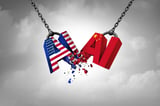
Seeking Alpha • Oct 2, 2026
U.S., China And The Race For Global AI Leadership