Breakthrough in DNA Integration: Engineered Recombinases Achieve High Efficiency and Specificity
November 6, 2025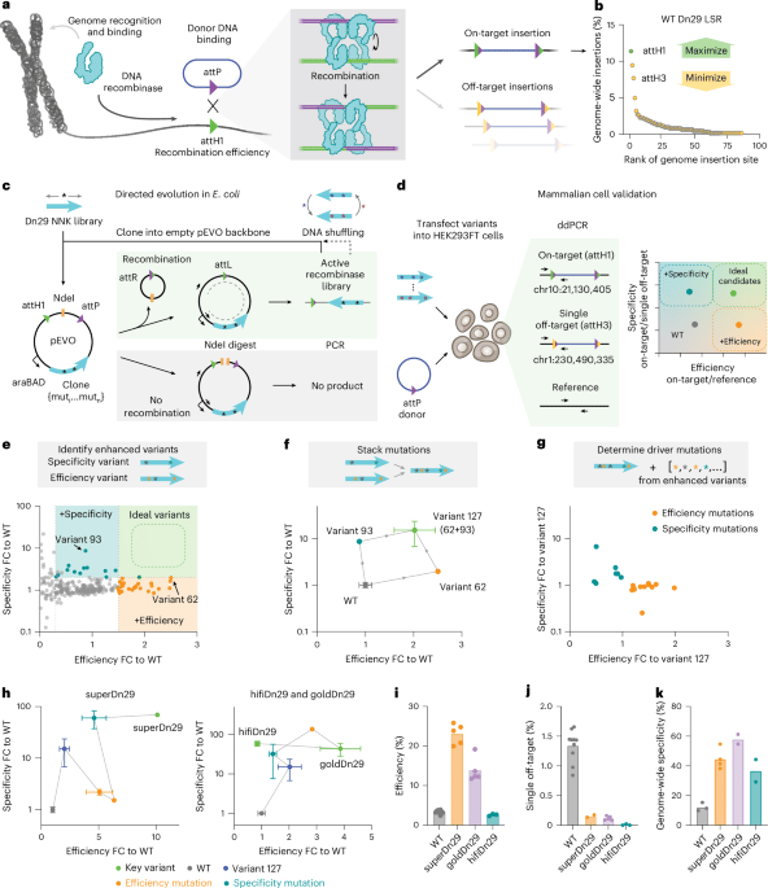

The integration of LSRs with dCas9 fusions further improves targeting by recruiting the recombinase to specific genomic sites, delivering large gains in efficiency (up to about 11.8-fold) and high specificity, with attH1 genome-wide specificity reaching 91–97% for the best fusions.
Computational modeling, including ridge regression and other linear approaches, supports predicting higher-order mutant activities from single-mutant data, enabling scalable design of future recombinase variants.
Structural analyses using AlphaFold3, compared to known integrase structures, reveal a hotspot for efficiency mutations in the coiled-coil hinge region and mutations that modulate DNA interactions and tetramer stability.
A three-pronged engineering framework was developed to boost on-target efficiency, reduce off-target insertions, and minimize the low-frequency off-target tail, employing metrics for efficiency, specificity, and genome-wide specificity.
Directed evolution through deep mutagenesis and iterative shuffling yielded variants with substantially improved performance, identifying key mutations driving efficiency (e.g., E70G, A224P) and specificity (e.g., N341K), and enabling stacking for superior profiles.
The study centers on the Dn29 recombinase as a proof of concept, establishing a baseline performance of 5% overall attH1 integration with a 12% share at the top site and several off-targets to guide subsequent engineering.
Optimal sgRNA design near the attachment site core was identified (roughly 40 bp from core), with guide orientation largely unimportant; exploring PAM variants and donor-encoded sgRNA binding sites further expanded efficiency and targeting scope.
Demonstrated generalizability across multiple LSR orthologs, achieving significant efficiency gains and improved specificity across Pf80, Nm60, and Si74 variants, suggesting broad applicability of the framework.
Final engineered variants—superDn29, goldDn29, and hifiDn29—exhibit dramatically higher specificity and notable efficiency gains, with genome-wide on-target integration rising from 12% in WT to 40–60% in engineered variants.
dCas9-based recruitment can bias integration toward a chosen pseudosite (attH1 or attH3), enabling controlled integration site selection and reduced off-target events across replicates.
Engineered large-site recombinases enable high-efficiency, site-specific DNA integration into the human genome without pre-installed landing pads, addressing prior limitations such as off-target insertions and dependence on host repair pathways.
Summary based on 1 source
Get a daily email with more Science stories
Source
Nature • Nov 6, 2025
Site-specific DNA insertion into the human genome with engineered recombinases