CU Boulder Engineers Advance Turing's Theory to Mimic Boxfish Skin Patterns with Mathematical Models
November 6, 2025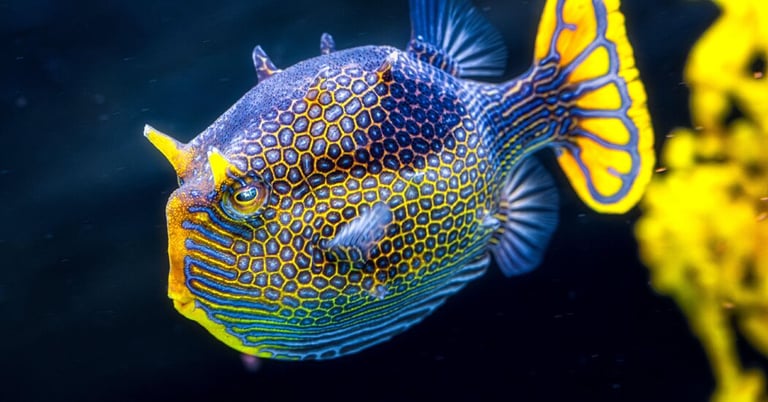

A University of Colorado Boulder engineering team extends Turing’s 1952 theory by incorporating diffusiophoresis, simulating how pigment cells move and clump to produce sharper yet imperfect patterns that resemble real boxfish skin.
Their simulations reveal natural imperfections in pattern formation, including varying stripe thickness, broken hexagon sides, and bleeding between spots and shapes.
The researchers envision broader applications, such as bio-inspired fabrics for camouflage and soft robotics, while noting the model remains a simplified representation that omits details like pigment production mechanisms.
Building on Turing’s legacy in pattern formation across biology and physics, the study connects mathematical models to real-world biological complexity and positions the boxfish work as a bridge to broader phenomena.
The project uses Turing’s reaction-diffusion framework to reproduce ornate boxfish patterns, including their imperfections, demonstrating how mathematical models can capture complex natural designs.
Summary based on 1 source
Get a daily email with more Science stories
Source
The New York Times • Nov 6, 2025
Where You See a Fancy Fish, Engineers See Alan Turing’s Math