New Study Links Alzheimer's to Disrupted Fat Tissue Communication, Paving Way for Novel Treatments
November 6, 2025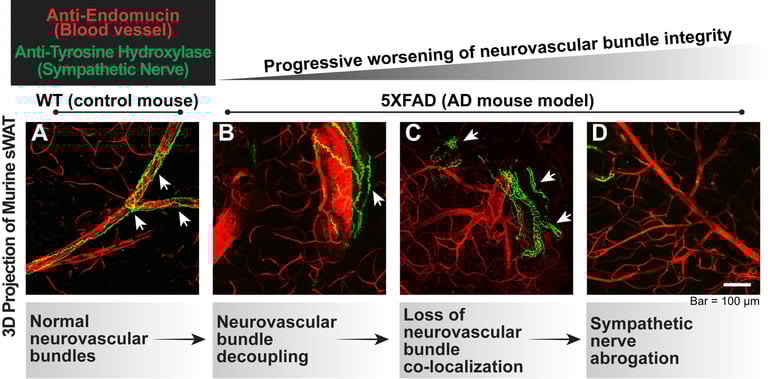

A Houston Methodist study shows that Alzheimer’s disease disrupts neurovascular communication in adipose tissue, linking neurodegeneration to systemic metabolic regulation.
Researchers indicate that addressing autonomic dysfunction could improve overall health outcomes for people with Alzheimer’s, opening new avenues for treatment and prevention.
Using three-dimensional imaging on mouse models, the team observed structural changes in nerve and blood vessel bundles in fat tissue caused by Alzheimer’s, especially affecting sympathetic nerves involved in fat metabolism.
Future work includes longitudinal studies to monitor therapy responses and identify biomarkers for early detection and treatment efficacy.
By combining advanced 3D imaging with computational biology, the researchers mapped neurovascular disruption and established a framework for longitudinal monitoring and biomarker development.
The study was funded by NIH grant U01CA253553 and Cure Alzheimer’s Fund.
The findings provide a mechanistic explanation for why Alzheimer’s co-occurs with vascular and metabolic conditions such as stroke, hypertension, and type 2 diabetes.
Adipose tissue is presented as an active neuro-metabolic organ that interfaces autonomic inputs with systemic metabolism, with broad implications for endocrinology, cardiovascular medicine, and neurology.
Summary based on 4 sources
Get a daily email with more Science stories
Sources
Medical Xpress • Nov 5, 2025
Alzheimer's can hijack communication between brain and fat tissue, potentially worsening metabolic health
News-Medical • Nov 5, 2025
Study sheds light on how Alzheimer's disease may contribute to larger health issues
BIOENGINEER.ORG • Nov 5, 2025
Alzheimer’s Disease Disrupts Brain-to-Fat Tissue Communication,