RWA Tokenization Revolutionizes Finance: Aiming for a Multi-Trillion-Dollar Digital Asset Market by 2030
May 24, 2026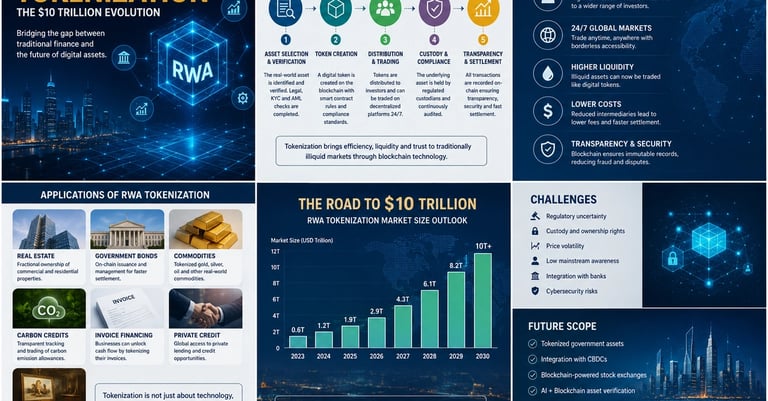


This ongoing evolution reshapes global finance by expanding access for investors, empowering developers, and defining a new generation of fintech with broader participation in 24/7 global markets.
Challenges identified include regulatory uncertainty, cross-jurisdiction custody and ownership rights, token price volatility, limited mainstream awareness, traditional bank integration, and cybersecurity risks.
Tokenized assets span real estate, gold, equities, invoices, commodities, art, and infrastructure, enabling programmable ownership, automated settlements, and borderless participation.
Applications include real estate tokenization, tokenized government bonds, commodity and carbon credit tokens, invoice financing, private credit markets, and tokenized art and luxury goods.
RWA tokenization is accelerating as a transformative trend in finance, turning physical and financial assets into on-chain tokens to unlock liquidity, enable fractional ownership, real-time transfer, and transparent auditing, with the aim of building a multi-trillion-dollar digital asset market by 2030.
Additional advantages include continuous, 24/7 global markets, reduced transaction costs, and fewer intermediaries through tokenization.
Future directions point to tokenizing government assets, integration with CBDCs, blockchain-based stock exchanges, AI-assisted asset verification, and potential global liquidity pools with Layer-2 scalability.
Notable players and institutions cited include MakerDAO, BlackRock, Ethereum Foundation, IMF, BIS, RBI, Ondo Finance, and the World Economic Forum.
Token creation involves asset verification (KYC/AML), issuance on standards like ERC-20 or ERC-3643, and smart contracts governing transferability and compliance.
A custody-and-compliance layer uses fiduciary custodians and regular audits to provide off-chain asset backing, bridging traditional law with blockchain.
Growth is driven by institutional blockchain adoption, rising investor demand for alternative assets, and advances in smart contracts and AI-enabled automation.
Benefits include increased liquidity for illiquid assets through fractional ownership, broader retail accessibility, and enhanced transparency and security via immutable records and automated compliance.
Summary based on 2 sources
Get a daily email with more Tech stories
Sources
DEV Community • May 24, 2026
REAL-WORLD ASSETS TOKENIZATION : THE $10 TRILLION EVOLUTION
Programming Insider • May 22, 2026
RWA Tokenization: The Next Trillion-Dollar Market Reshaping Global Investments - Programming Insider