China Unveils Sugon 8000: A Leap in Exascale Supercomputing Amidst US Sanctions
November 3, 2026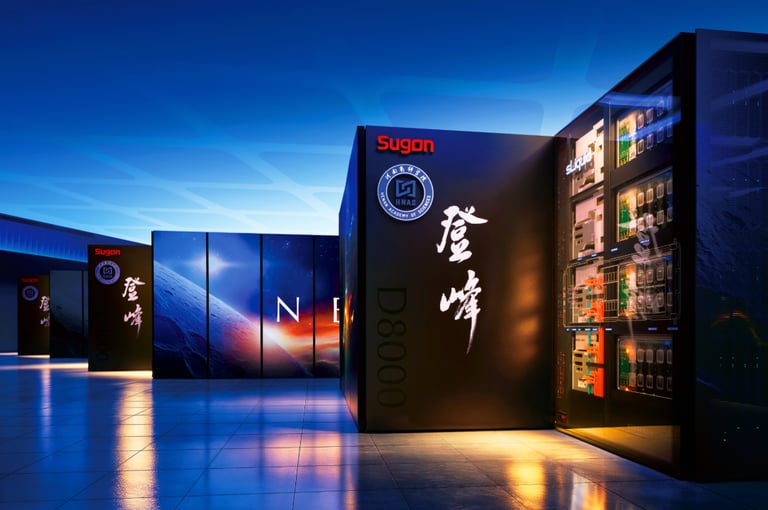

The Sugon 8000 is a 100,000-card supercluster developed by Sugon Information Industry Co., built on Hygon X86-compatible CPUs and AI accelerators, and uses Sugon’s new scaleFabric interconnect with a 400G/800G RDMA network.
China’s exascale push now includes LineShine, Sunway Oceanlite, Tianhe-3, and the Sugon 8000, suggesting at least four exascale-class machines, with American systems unlikely to top the list at SC26 according to the report.
The system employs immersion phase-change liquid cooling for high power-density, single-cabinet MW-class deployment, aligning with China’s HPC-AI fusion strategy.
Storage is provided by Sugon’s ParaStor flash-based parallel file system, which Sugon has submitted to the IO500 list, achieving first place in full-node and 10-node rankings.
There is substantial uncertainty about technical specifics—processor count, accelerators, memory type and size, rack count, and power requirements—and whether it will appear on the TOP500 list at SC26.
The Sugon 8000’s development followed US sanctions on THATIC and Sugon, prompting China to pursue in-house chip development rather than relying on AMD technology for this system.
Dengfeng is designed to support a wide range of workloads—from FP64 scientific computing to INT8 AI inference—and represents a move to 100,000-card scale beyond earlier 1,000- and 10,000-card clusters.
Sugon claims the 8000 already supports about 300 applications, including large AI models, drug discovery, astronomy, and quantum computing, with 70 applications validated on the 10,000-card expansion to 100,000 cards.
China publicly acknowledges four exascale-class systems, with Dengfeng/Sugon 8000 unveiled in Zhengzhou at the National Supercomputing Center and linked to the National Supercomputing Internet.
Summary based on 1 source
Get a daily email with more Tech stories
Source
HPCwire • Nov 3, 2026
China Finally Debuts Fourth Exascale System, Sugon 8000