Tiny QR Codes Revolutionize Honeybee Tracking, Reveal Longer Lifespans and Foraging Patterns
January 28, 2025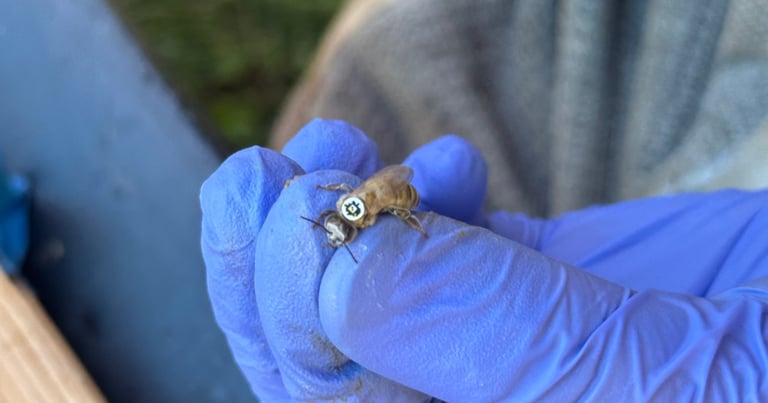

Researchers at Penn State University have developed an innovative method to study honeybee movement by attaching tiny QR codes, smaller than a pinky nail, to the backs of approximately 32,000 bees.
This automated imaging system continuously monitors the bees' movements, allowing researchers to track individual bees as they leave and return to the hive.
Preliminary findings reveal that most foraging trips are brief, typically under five minutes, although some bees can venture out for up to two hours.
Study co-author Margarita López-Uribe noted that during these longer journeys, bees may explore and some may not return to the colony.
The study suggests that placing hives in areas with high-quality food sources can limit the bees' foraging range, which is advantageous for beekeepers.
This new tracking method aims to replace traditional fieldwork reliant on limited human observations, making it replicable across various landscapes.
Researchers used a minimal amount of non-toxic superglue to attach the tags, ensuring the safety of the bees, and managed to keep them still by cooling them temporarily.
Contrary to the common belief that bees live around 28 days, data indicates they can forage for up to six weeks, suggesting longer lifespans than previously thought.
Ultimately, the research aims to enhance organic beekeeping standards in the U.S., providing valuable insights for both scientists and beekeepers.
This research is part of a larger project that will also explore the foraging distances of bees using radar technology and transponders.
The study seeks to determine how far bees travel from their hives for foraging, contributing to the understanding of their travel and feeding patterns, which are critical to agricultural systems.
The findings from this research were published in the journal HardwareX, showcasing the collaborative efforts of biologists, entomologists, and engineers.
Summary based on 3 sources
Get a daily email with more Science stories
Sources
CBS Pittsburgh • Jan 28, 2025
Penn State researchers equip thousands of honeybees with tiny QR codes for science
CNN • Jan 28, 2025
Tiny QR codes help scientists track bee movements | CNN
WGAL • Jan 30, 2025
Penn State researchers use QR codes to track honeybee movements