Vietnam's Key Congress and Elections: Charting Future Growth and Leadership Amid Global Challenges
December 22, 2025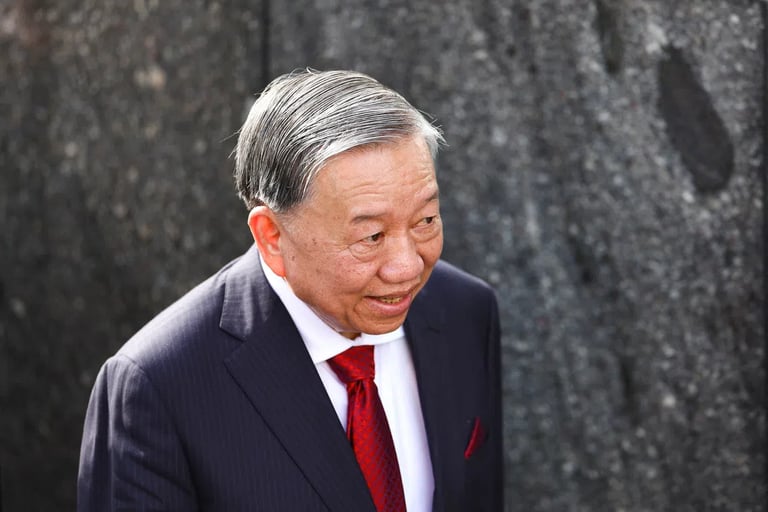

Parliamentary elections in March–May will see lawmakers endorse the party’s choices for top state roles, including president, prime minister, parliamentary speaker, ministers, and the head of the central bank, highlighting the party chief’s central role.
The upcoming congress and elections will determine both leadership and policy paths, shaping how aggressively Vietnam pursues growth, private-sector development, and international engagement under a stable, centralized leadership.
Public spending will rise to fund infrastructure, with the long-term objective of reaching high-income status by 2045.
Current party chief To Lam, 68, who took over after Nguyen Phu Trong’s death in July 2024, is seeking a second term and has implemented reforms, tightened security, and expanded police powers while pursuing Bamboo Diplomacy to balance ties with China, the United States, and Russia.
Leading candidates are expected to be shortlisted by the party ahead of the congress, underscoring the centrality of the party chief as the most powerful position in recent years.
The draft policy report outlines a higher-growth model in response to tariffs on exports to the United States, reflecting efforts to modernize the economy amid global trade pressures.
Vietnam’s policy evolution traces back to the Doi Moi reforms in the late 1980s, which propelled the country to become one of Asia’s fastest-growing economies.
The Communist Party has ruled Vietnam since its founding in 1930 and has maintained single-party governance since reunification in 1975, with no opposition allowed.
Vietnam’s leadership relies on collective decision-making and maintains a stable foreign policy that balances relations with China, the U.S., and Russia; while To Lam moved away from the term Bamboo Diplomacy, the strategy remains the guiding approach.
Vietnam’s 14th five-year congress will run from mid-January 2025 to elect top leaders and set policy targets through 2030, with about 1,600 delegates selecting around 200 Central Committee members who will choose the Politburo and the general secretary.
The 2030 targets aim for at least 10% annual GDP growth from 2026 to 2030, a growth model driven by private enterprise under state guidance, expanded infrastructure spending, and a budget deficit near 5% of GDP over the next five years.
Summary based on 8 sources
Get a daily email with more World News stories
Sources
U.S. News & World Report • Dec 22, 2025
Explainer-How a Five-Yearly Communist Party Congress Will Pick Vietnam's Next Leaders

StreetInsider.com • Dec 22, 2025
Explainer-How a five-yearly Communist Party congress will pick Vietnam's next leaders
The Business Standard • Dec 22, 2025
How a five-yearly Communist Party congress will pick Vietnam's next leaders