KAIST's Humanoid Robot Achieves High-Speed Locomotion and Versatility with Physical AI
March 23, 2026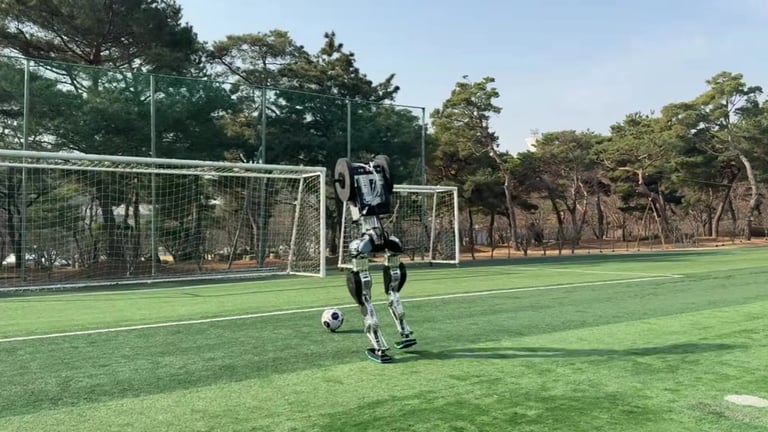

KAIST’s DRCD Lab has built an in-house humanoid robot using independently developed actuators and hardware, guided by a Physical AI approach that blends software intelligence with physical systems for real-world interaction.
On flat ground the robot can reach 7.3 mph (12 km/h) and climb over 12-inch steps, with targets to hit 14 km/h on wheels, ladder climbing, and 40 cm step ascent.
KAIST’s broader initiative emphasizes collaborative intelligence and continuous learning through simulation and real-time feedback rather than relying solely on historical data.
The plan is to evolve the robot into a full humanoid with an upper body to meet industrial-site demands, using human demonstrations to learn via the DynaFlow framework.
A Quasi-Direct Drive design with a custom 3K compound planetary gearbox delivers high torque, fast response, and compact actuation for running, jumping, and rapid direction changes.
KAIST Humanoid v0.7 weighs about 75 kg (165 pounds) and stands roughly 1.65 meters tall, with field tests showing high-speed locomotion, soccer-like actions, dancing, and balancing on uneven terrain.
In field tests, KAIST Humanoid v0.7 demonstrated near-flawless moonwalk capability on astroturf alongside walking, jogging, jumping, and kicking a ball.
Deep reinforcement learning combined with human motion data and Motor Operating Region modeling helps keep movements smooth and reduces jerkiness by aligning simulations with hardware limits.
Engineers aim to enhance mobility and dexterity further so the Humanoid can carry items or operate machinery, advancing Physical AI in real-world tasks.
KAIST is highlighted as a leading Korean research institution with strengths in AI, robotics, physics, and engineering, comparable to top global universities.
Physical AI integrates brain–body coordination so robots can act, react, and collaborate in real time on real-world tasks beyond symbolic computation.
The DRCD Lab combines hardware independence with AI controllers through modular residual learning and proprioception-based navigation, enabling terrain versatility without relying on vision sensors.
Summary based on 2 sources
Get a daily email with more Tech stories
Sources
Digital Trends • Mar 23, 2026
Watch this moonwalking humanoid robot impress with lifelike agility
Interesting Engineering • Mar 20, 2026
Video: South Korea’s KAIST humanoid robot dances and shoots goals in field test demo