Osaka Researchers Unveil Battery-Free Wireless EEG System Powered by Body Heat
April 27, 2026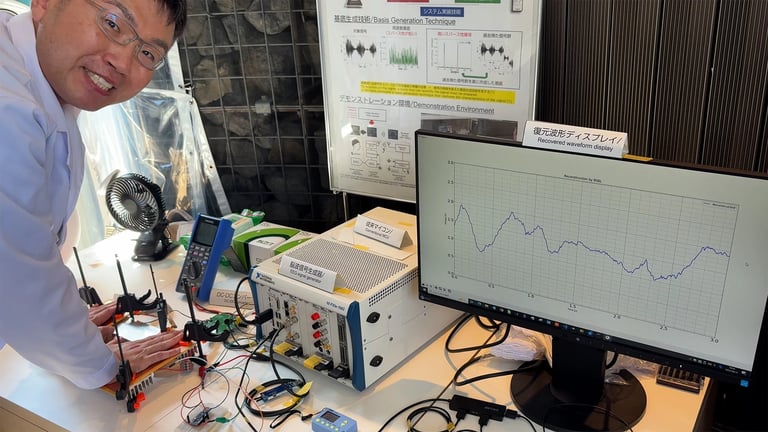

A team from The University of Osaka demonstrated a wireless EEG transmission system powered entirely by energy harvested from the temperature difference between the human body and the surrounding air, enabling maintenance-free operation.
The technology could enable maintenance-free health monitoring devices and sensor networks for infrastructure, environmental monitoring, and smart-city deployments.
The research, published in the Proceedings of the IEEE International Conference on Consumer Electronics, presents a battery-free approach that relies on compressed sensing and body–ambient temperature energy harvesting.
It uses data undersampling and a receiver-side reconstruction algorithm to reliably recover EEG signals with minimal transmitted data, removing the need for an external power source.
The demonstration indicates continuous wireless EEG transmission is feasible even with small body–ambient temperature differences, showing real-world robustness beyond lab conditions.
Lead author Daisuke Kanemoto underscores the long-term aim of sensing systems that can operate indefinitely without maintenance, broadening opportunities for health, infrastructure, and environmental sensing.
The tech was demonstrated outdoors at Expo 2025 in Osaka, with ambient temperatures around 32°C and without any external power or airflow.
Summary based on 1 source
Get a daily email with more Science stories
Source

Asia Research News • Apr 27, 2026
No batteries, just body heat: demonstrating the potential of battery-free sensing