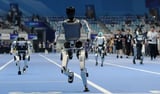
Global Robotics Race Heats Up: KAIST Unveils Advanced Humanoid with Soccer Skills and AI Integration
May 9, 2026

Global competition in humanoid robotics is heating up as researchers, tech firms, and universities race to deploy autonomous systems in real-world environments, signaling rapid progress in AI-driven mobility that has captured the attention of researchers, developers, and investors alike.
Soccer-style movements are used as benchmarks to demonstrate advanced motor control and predictive motion in humanoid robots.
Practical real-world applications—from logistics and warehouse work to disaster response and mobility assistance—depend on a robot’s carrying capacity and agile performance.
KAIST unveiled a 75-kilogram humanoid robot capable of running up to 13 km/h while carrying 20 kilograms, and performing dynamic jumps and soccer-like movements with maintained balance.
AI integration, computer vision, and sensor advancements are accelerating robots’ perception, decision-making, and environmental adaptation.
South Korea, led by KAIST, is strengthening its position as a global hub for robotics, AI, semiconductors, and advanced manufacturing.
Ethical, regulatory, privacy, and governance debates accompany rapid robotics advancement, including concerns about employment disruption.
Labor shortages and aging populations are driving automation across logistics, manufacturing, healthcare, and infrastructure, fueling robotics and AI investment.
Robots are expanding from industrial settings into logistics, healthcare, disaster response, mobility assistance, and service sectors.
Analysts expect continued rapid progress in humanoid robotics as hardware and AI improve, enabling more complex tasks across multiple industries and public spaces.
Maintaining balance under load remains a core engineering challenge essential for realistic, human-centered robotics.
KAIST’s breakthrough exemplifies the accelerating evolution of human-like mobility and underscores the global race to develop intelligent machines for human-centered environments.
Summary based on 3 sources