Saudi Arabia Releases Guidelines to Mitigate Deepfake Risks and Foster Innovation
May 9, 2026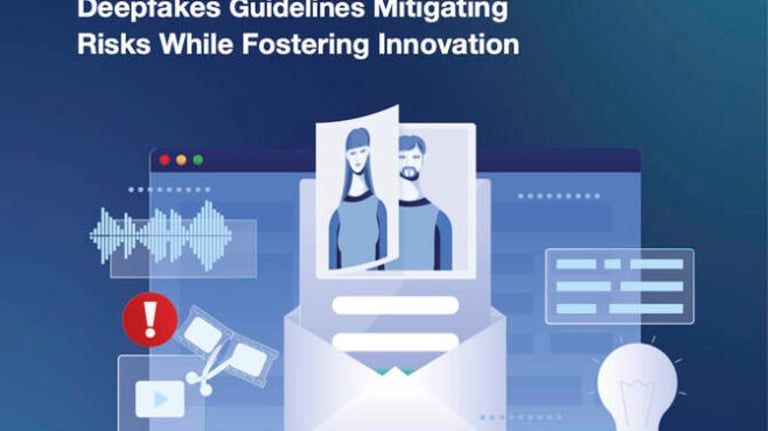

Victims should document evidence, report to platforms and authorities, and use the three-step approach to guide response and escalation.
Content creators must avoid using deepfakes for fraud, impersonation, or defamation; apply tamper-resistant watermarks, obtain explicit consent, maintain auditable consent records, and distribute content securely with blockchain or hashing to trace alterations.
Regulators should monitor high-risk domains, require formal approval for commercial deployment, adopt provenance standards (C2PA), and enforce penalties proportionally, with audits, inventories, training for public officials, and public awareness campaigns.
The threat landscape includes impostor scams, non-consensual manipulation, and disinformation, with emerging risks like near-perfect AI-generated voicescams and fully fabricated virtual environments.
Ethical deepfake use can benefit healthcare, education, culture, and entertainment; guidelines emphasize continuous learning, organizational preparedness, and commitment to ethical innovation.
Saudi Arabia’s SDAIA released the Deepfakes Guidelines: Mitigating Risks While Fostering Innovation (document SDAIA-P119, May 2025) to regulate synthetic media and promote responsible use.
Victims should document evidence, report content to platforms and authorities (e.g., Kollona Amn app, Cybercrime Unit), and involve legal or digital forensics support; financial fraud cases should be reported to the Saudi Central Bank.
Deepfakes are hyper-realistic synthetic media created with deep learning; risks depend on intent and application, with six sectors identified for potential beneficial use (marketing, entertainment, retail, education, healthcare, culture).
A consumer-facing three-step detection framework advises: first, assess the source and context; second, inspect audio-visual cues such as lip-sync, facial movements, blinking, and lighting; and third, employ AI-based detectors (e.g., Deepware Scanner, Sensity AI) along with provenance tools (Adobe CAI, blockchain verification) to verify authenticity.
Developers must comply with privacy laws (PDPL, Anti-Cyber Crime Law) and international standards (GDPR, CCPA), embedding privacy-by-design, anonymization, consent management, non-intrusive watermarks, model documentation, explainability, and human-in-the-loop oversight.
The full SDAIA Deepfakes Guidelines document is available on the SDAIA website (SDAIA-P119, May 2025).
Summary based on 3 sources
Get a daily email with more AI stories
Sources

Arab News • May 9, 2026
SDAIA issues deepfakes guidelines to regulate responsible AI use
Arabnews • May 9, 2026
SDAIA issues deepfakes guidelines to regulate responsible AI use
Arab News Japan • May 9, 2026
SDAIA issues deepfakes guidelines to regulate responsible AI use