CUREE Robot Revolutionizes Coral Reef Mapping with Precision and Autonomous Exploration
May 14, 2026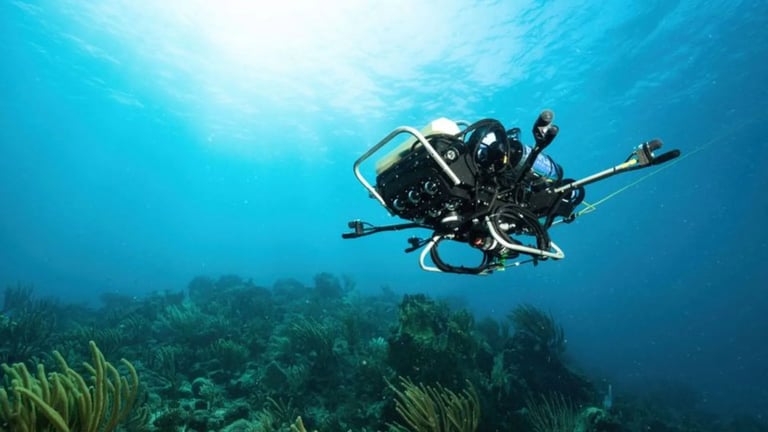

CUREE uses a combination of distant acoustic signals and near-field visual data to detect reef activity up to 80 meters away and autonomously converge on hotspots from about 30 meters, enabling continuous, high-resolution reef mapping.
The robot can locate sound sources up to 80 meters away and converge on reef hotspots at distances up to 30 meters, including following sentinel species like barracuda to identify ecologically important areas.
Lead researcher Yogesh Girdhar stressed the need for smarter, faster ways to identify where life persists to focus conservation and management efforts.
Understanding sub-meter biodiversity patterns and habitat correlates is crucial for reef health and resilience, enabling better-informed conservation and management decisions.
Seth McCammon and Yogesh Girdhar emphasize that the technology augments human observation, offering capabilities beyond what divers can achieve, while complementing traditional reef surveys.
Background context notes coral reefs occupy less than 0.01% of the ocean but support about a quarter of marine species, while facing warming, disease, overfishing, and coastal development threats.
Field trials from 2022 to 2024 at Joel’s Shoal in the U.S. Virgin Islands consistently identified a biodiversity hotspot around a large pillar coral, with fish densities about 25 times higher near the feature and elevated acoustic activity over a larger area.
Demonstrations included tracking biological sounds like snapping shrimp and fish calls to navigate toward areas of interest without prior reef knowledge, indicating potential to discover uncharted habitats.
Passive acoustics reveal broad, distant activity while cameras provide near-field detail, and together they outperform either method alone in locating biologically rich zones.
Sound-guided navigation follows biological signals and then is confirmed with visual observations, increasing accuracy in complex reef environments.
The system combines audio and visual data in real time to identify areas of higher biological activity, addressing limitations of traditional diver surveys and enabling safer, longer-term monitoring.
An autonomous underwater robot named CUREE (Curious Underwater Robot for Ecosystem Exploration) developed by WHOI can map coral reef biodiversity hotspots with centimeter-scale precision by integrating visual surveys, acoustic mapping, sound-guided navigation, and tracking sentinel species.
Summary based on 2 sources
Get a daily email with more Science stories
Sources
Interesting Engineering • May 13, 2026
New autonomous reef robot follows shrimp snaps and fish calls to map marine life zones
Newswise • May 13, 2026
Autonomous underwater robot discovers hidden coral reef “hotspots” | Newswise