AI Market Booms: Europe and North America Lead with Massive Growth by 2035
June 19, 2026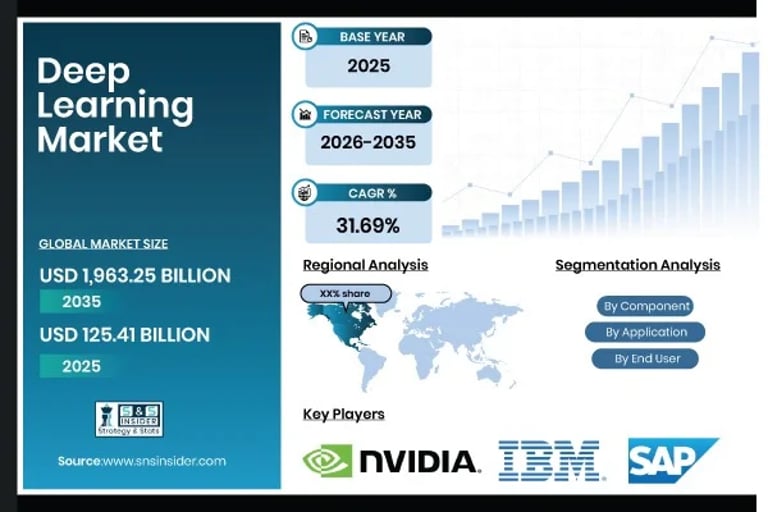

Asia-Pacific is set to show the highest growth, led by China’s AI investments and platforms from Baidu and Alibaba, with notable adoption in Japan and India contributing to roughly 44.8% of APAC revenues.
Industry trends shaping the market include a shift to energy-efficient computing, expanding AI infrastructure, bigger datasets, more complex models, and higher training costs.
Image Recognition leads the market in 2025 with about 43% share, supported by applications in facial recognition, medical imaging, quality inspection, and autonomous vehicle perception, while Data Mining is the fastest-growing segment with a CAGR near 34.98%.
Software accounts for around half of the market in 2025, while Hardware remains the fastest-growing segment due to rising GPU and specialized AI chip demand.
The global AI market is expanding rapidly, with Europe projected to grow from about USD 32 billion in 2025 to USD 452 billion by 2035, roughly a 30% CAGR, propelled by EU AI Act regulation and industrial adoption in automotive and manufacturing.
North America is on a steeper growth path, rising from around USD 37 billion in 2025 to roughly USD 596 billion by 2035, driven by generative AI adoption and large-scale AI infrastructure investments across the region.
Recent hardware and edge AI developments underline the momentum, including NVIDIA’s 2024 Blackwell B200 GPU and Microsoft’s Phi-3 Mini edge LLM for on-device deployment.
Generative AI adoption and enterprise automation are the main drivers of surging model-training demand across healthcare, finance, automotive, and industrial sectors.
North America dominated 2025 market activity, anchored by extensive AI infrastructure investment and the presence of frontier model development from major tech players like Google, Microsoft, NVIDIA, Meta, and Amazon.
In end-user applications, Healthcare & Life Sciences holds about 22% of 2025 revenues, while Automotive & Transportation ranks as the fastest-growing segment due to autonomous driving, ADAS, and connected vehicle AI.
Summary based on 2 sources