Horizon 1000: $50M AI Initiative to Revolutionize Healthcare in Sub-Saharan Africa by 2028
August 28, 2026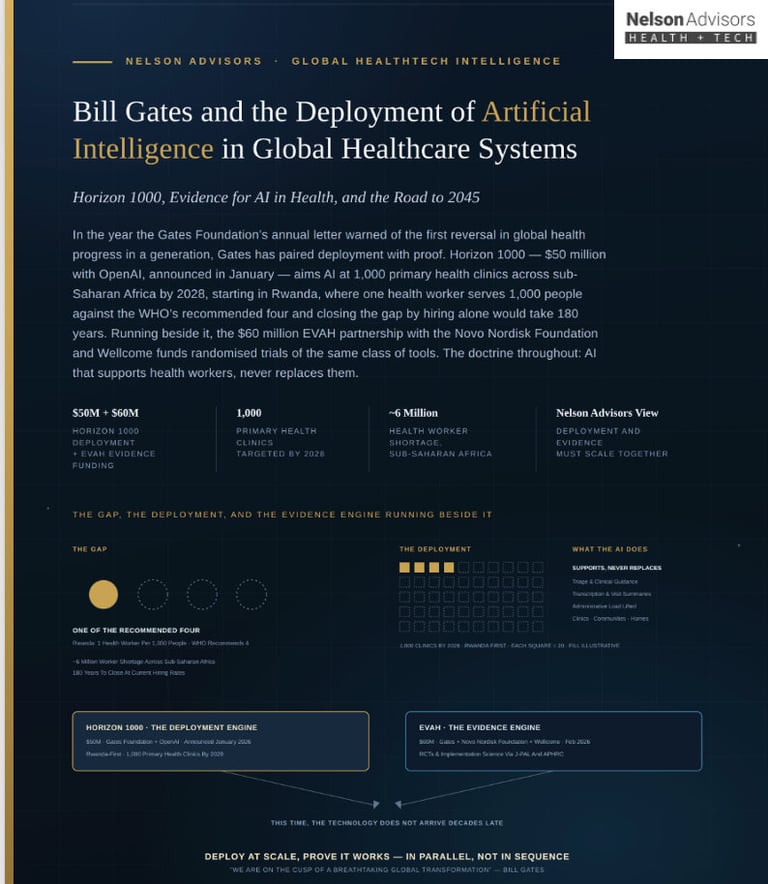

A Gates Foundation–OpenAI initiative, Horizon 1000, with $50 million, aims to deploy context-aware AI tools in 1,000 primary care clinics across Sub-Saharan Africa, starting with a pilot in Rwanda, by 2028 to integrate local LLMs into triage and decision-support workflows.
AI is viewed as a mechanism to close the innovation diffusion gap for LMICs, with deliberate policy interventions and targeted philanthropic funding to prevent widening health disparities.
Governance and ethics are central, addressing biosecurity, algorithmic bias, data sovereignty, and labor practices, while acknowledging risks such as dual-use AI for bioweapons, Western-centric data biases, and potential crowding out of traditional health investments if AI substitute funding prevails.
AI accelerates advanced diagnostics and R&D, speeding vaccine discovery, drug development, and low-cost diagnostics, including AI-assisted retinal imaging for cardiovascular risk, handheld ultrasound with AI guidance, and VectorCam for malaria control.
AI tools are positioned as force multipliers to cut non-clinical workloads—dictation, EMR generation, claims processing, and triage—so frontline workers can devote more time to patient care.
Rwanda is a focal point for data-sovereignty efforts, leveraging Digital Umuganda to build open local-language datasets so AI tools reflect and benefit local communities.
Milestones from GPT-4’s mid-2020s capabilities underscore AI as a cognitive partner for high-stakes fields like healthcare and law through precise data retrieval and qualitative reasoning.
Local innovation is encouraged through Grand Challenges and seed grants up to $100,000 for LMIC researchers and developers, enabling solutions tailored to languages, cultures, and clinical needs (e.g., Awaaz-e-Sehat, Shout-It-Now, KIKO, RHInnO Ethics).
Key partnerships include a $200 million Gates-AI collaboration with Anthropic to broaden access to high-capacity AI for health, agriculture, and education, alongside IHME collaboration to mesh AI with Global Burden of Disease data for policy.
Bill Gates characterizes AI as a civilizational leap with the potential to reduce health inequities in LMICs, comparing its impact to the microprocessor, internet, and mobile revolutions.
LMIC health systems face severe workforce deficits, with Sub-Saharan Africa missing millions of healthcare workers and Rwanda’s ratios illustrating shortage pressures that contribute to delayed triage and lower care quality.
The EVAH initiative, a $60 million collaboration among Gates Foundation, Novo Nordisk Foundation, and Wellcome Trust, funds RCTs, implementation science, and health economics to evaluate AI decision-support tools in LMICs.
Summary based on 1 source
Get a daily email with more AI stories
Source
Nelson Advisors • Aug 28, 2026
Bill Gates and the Deployment of Artificial Intelligence in Global Healthcare Systems