Salesforce's Future: AI-Driven Cross-Platform Integration and Enhanced Collaboration with Headless 360
September 19, 2026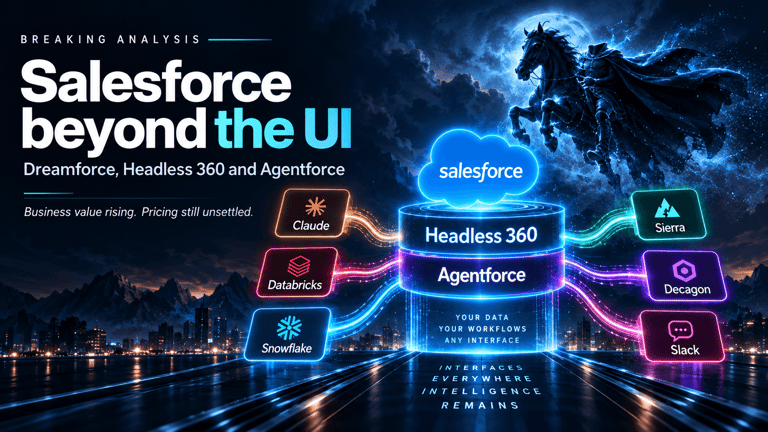

Salesforce’s long-term growth hinges on integrating enterprise context and workflows with AI agents that operate across multiple applications, not just within Salesforce’s own interface.
Headless 360 enables access to Salesforce functionality outside the traditional UI, with agents generating interfaces on demand in environments like Claudeforce, Slackforce, and Agentforce Coworker, making Slack a collaboration-native system of engagement.
Data 360 and Customer 360 provide the business context and semantic workflows that agents need to operate across enterprise data silos, enabling cross-functional automation rather than siloed tasks.
Qualitate’s interviews with 20 customers show most are in pilot stages for Agentforce, and about three-quarters of those who modeled headless access expect Salesforce spending to rise, indicating higher consumption rather than lower costs.
Salesforce positions Databricks and Snowflake as foundational data platforms, with Data 360 layering over them to offer composable, value-adding context without mandating a full platform replacement.
An enterprise AI framework is introduced—comprising the system of engagement (SoE), system of intelligence (SoI), and system of agency (SoA)—all integrated in an enterprise AI harness that threads data, business knowledge, workflows and governance.
A harmonized business map for agents is essential so they can act on data and processes across systems, with emphasis on memory, context, and robust governance and security to enable adoption.
Salesforce aims to extend beyond its own UI by allowing AI agents to generate task-oriented interfaces in client surfaces like Claude and Slack, enabling users to start from outcomes rather than Salesforce screens.
Summary based on 1 source
Get a daily email with more AI stories
Source

SiliconANGLE • Sep 19, 2026
Salesforce after Dreamforce: How the CRM giant can grow beyond its own interface