MIT Unveils Ultra-Thin Biohybrid Robot with Living Muscle Fins for Environmental Monitoring
October 23, 2026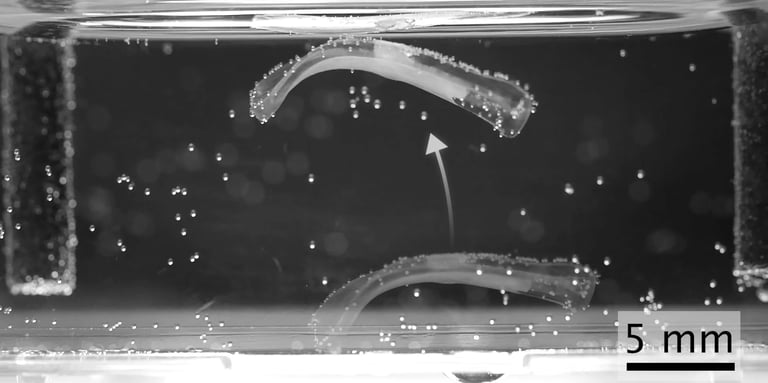

Researchers at ETH Zurich co-designed living skeletal muscle tissue with a soft 3D-printed hydrogel scaffold to create integrated bioactuators, optimizing muscle placement and scaffold properties via computer simulations for maximum motion, with the study published in Nature Communications.
The bioactuators, about 1.5 cm long, combine cultured mouse muscle tissue with a hydrogel scaffold and move visibly, with the design process involving simultaneous computer-based optimization of muscle geometry and scaffold characteristics before fabrication.
A small robot, roughly the size of a gum stick, demonstrated swimming and navigation through a simple underwater maze, achieving up to four body lengths per minute.
Potential future applications include environmental monitoring in aquatic settings and operations in delicate or unpredictable environments where conventional machinery may be unsuitable.
The two-fin design functions as two independent muscles, enabling directional control by illuminating one or both fins.
Repeated light pulses strengthened the muscle tissue before incorporation into the robot, improving contraction strength.
Compared with traditional bulkier biohybrid robots, this approach aims to reduce manufacturing costs and improve efficiency by using a thinner, two-dimensional muscle layer.
The research received partial funding from the Office of Naval Research.
Stable, efficient force transfer requires firm anchoring via grooves in the scaffold, though viability today depends on a nutrient bath and an artificial vascular system for longer-term or larger-scale use, highlighting both promise and remaining challenges.
Future challenges include longer-term viability through vascularization and managing biological variability in living tissue to achieve consistent robotic performance.
Although promising, current biohybrid robots require nutrient solutions to sustain living tissue and will need an artificial blood supply for long-term viability in larger systems.
To maximize performance, the team replaced the softer fibrin base with GelMA, optimized gel stiffness, and used square grooves to align muscle fibers for stronger contractions.
Summary based on 3 sources
Get a daily email with more Science stories
Sources

ScienceDaily • Oct 23, 2026
MIT scientists build a tiny robot that swims using living muscle cells
Technology Org • Oct 24, 2026
One small leap for a muscle, one giant step for robotics - Technology Org