MIT Unveils Ultra-Thin Biohybrid Robot with Living Muscle Fins for Environmental Monitoring
October 23, 2026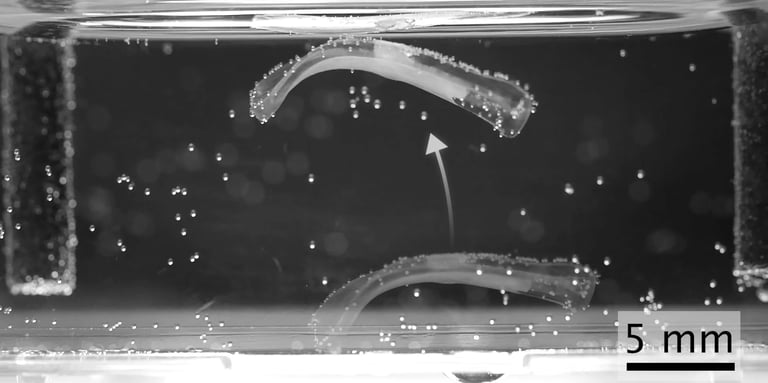

MIT researchers have built an ultra-thin biohybrid swimming robot by embedding a single layer of living muscle cells in a soft gel framework that forms two independently controllable fins.
A seamless, firm connection between muscle tissue and the scaffold is achieved with scaffold grooves that anchor and align fibers, minimizing strength loss during transfer.
The bioactuators are about 1.5 cm long, created by 3D-printed (xolography) scaffolds paired with cultured mouse muscle tissue, producing visible movement.
Potential future applications include environmental monitoring in aquatic settings and operations in delicate or unpredictable environments where conventional machinery falls short.
Repeated light pulses strengthened the muscle tissue before integration into the robot, boosting contraction strength.
Long-term viability will require nutrient solutions for living tissue and an artificial blood supply for larger, more capable systems.
The actuators can jump, swim, surface-locom, and grasp, with contractions lifting about 5 millimetres and surface-walking actuation around 6.2 millimetres per second per body length, outperforming earlier biohybrid designs.
This project showcases a multidisciplinary collaboration across cell biology, materials science, robotics, and CAD, signaling a path toward more bio-inspired robotic systems.
The two-fin design functions as two independent muscles, enabling directional control by activating one fin or both.
Funding includes support from the Office of Naval Research.
Computer simulations optimize the muscle-scaffold configuration to maximize movement before fabrication.
Compared with bulkier systems, this approach aims to reduce manufacturing costs and improve efficiency with a thinner, two-dimensional muscle layer.
Summary based on 2 sources
Get a daily email with more Science stories
Sources

ScienceDaily • Oct 23, 2026
MIT scientists build a tiny robot that swims using living muscle cells
Technology Org • Oct 24, 2026
One small leap for a muscle, one giant step for robotics - Technology Org