Personalized Foot Models Enhance Predictive Walking Simulations, Boosting Clinical Accuracy
October 26, 2026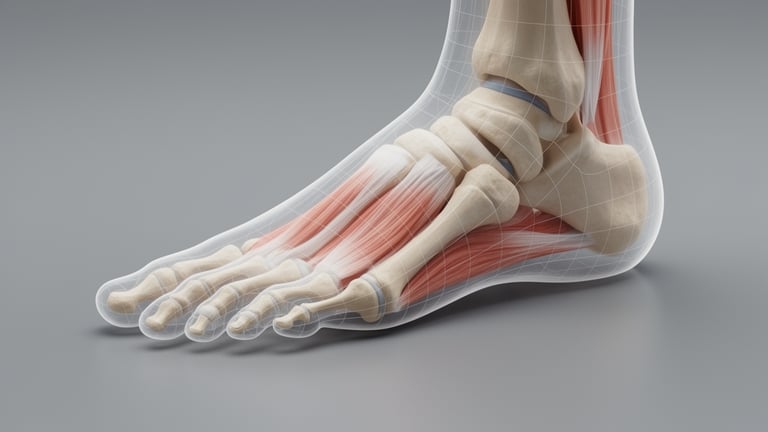

A study in the Annals of Biomedical Engineering shows that personalized foot-ground contact models significantly improve the accuracy of predictive walking simulations versus generic models.
The authors conclude that personalizing foot-ground contact yields meaningful accuracy and efficiency gains for predictive walking simulations, with potential clinical value when only motion data are available.
Data came from three subjects with varied health conditions—a healthy male, a stroke survivor with right-sided hemiparesis, and a male with pelvic sarcoma—captured with marker-based motion and instrumented treadmill ground reaction forces.
Researchers used two optimization approaches: calibration optimization to reproduce ground reaction and foot motion data, and tracking optimization to estimate ground reactions and joint loads from kinematics while enforcing dynamic consistency.
Limitations include dependence on high-quality marker data, torque-driven simulations without muscle dynamics, and calibration based on a single gait cycle; future work should test multiple cycles and noisier data.
The study tackles estimating ground reaction forces outside the lab by calibrating contact parameters to individual subjects.
Personalized models reduced computation time in tracking optimizations for two of the three subjects, indicating efficiency benefits.
Automated tools like the Neuromusculoskeletal Modeling Pipeline can streamline personalization, making it feasible for broader use by researchers and clinicians.
Simply increasing contact element density in a generic model did not replicate personalization benefits; tuning parameters to individual anatomy is essential.
Compared with generic models, personalized models lowered RMS errors in ground reaction forces and moments by roughly 40–60% in calibration and 60–80% in tracking.
Summary based on 1 source
Get a daily email with more Science stories
Source
BIOENGINEER.ORG • Oct 26, 2026
Personalized Foot Models Improve Walking Simulation Accuracy