Global Forum Charts AI's Future in Medicine: From Rapid Response Systems to AI Surgery
November 2, 2026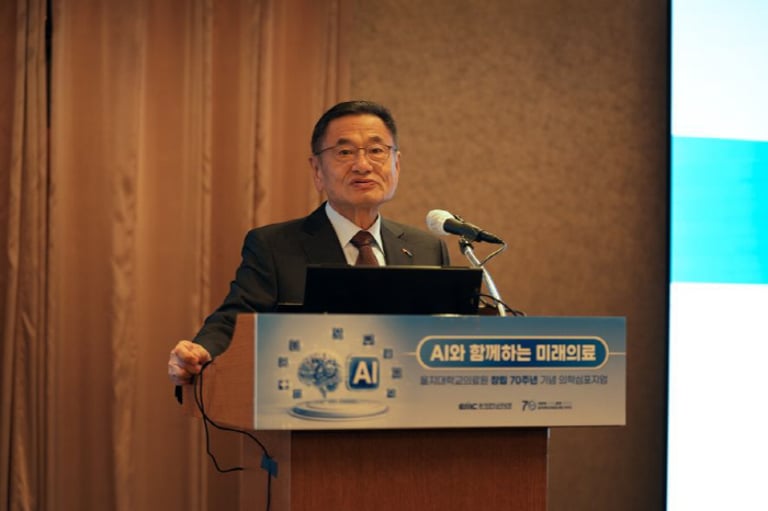

The forum showcased AI-assisted clinical applications, including rapid-response systems for early recognition of critically ill patients, AI’s role in radiology, and the development of on-device optimization and digital-twin simulations for AI-enabled surgery.
Discussions highlighted AI- and robotics-based healthcare systems, with emphasis on physical AI in surgical robotics, medical robot development directions, and AI-powered hospital operations and patient-care platforms.
Chairman Park Jun-young of the Eulji Foundation pledged continued support and investment to keep future medicine competitive and accessible, underscoring broader goals to expand healthcare access and AI integration in clinical settings.
Korean government officials outlined the AI Basic Medical Care Strategy, including regional AI care expansion, digital infrastructure, university-hospital AI transformation, and updates to reimbursement frameworks for AI-based services.
Lee Byung-hoon, chair of the organizing committee, described the symposium as a global forum for exchanging knowledge on medical AI, big data policy, and future directions, with plans to push AI and digital technologies across care, research, and education for the next century.
Seo Jun Beom noted that medical AI is evolving from diagnostic aid toward prevention and daily health management, pointing to examples like AI-assisted monitoring for diabetics.
Officials stressed patient-centered AI development aimed at reducing healthcare gaps and ensuring broad access to innovation.
The forum framed medical AI as expanding across prevention, treatment, and patient-centered care, while calling for robust clinical validation, data infrastructure, patient safety, and clinician responsibility.
Jaeseung Jeong of KAIST discussed humanoid AI and the growing role of AI and robotics in medicine and caregiving, urging physicians to maintain a human-centered approach as technologies expand diagnostics and surgery.
A KAIST professor emphasized the enduring importance of clinicians’ judgment and patient understanding in an AI-enhanced future, maintaining medicine as a human-centered field.
The event, held at the Lotte Hotel in Seoul, brought together leaders from Eulji Foundation, the medical center, Korea’s Ministry of Health and Welfare, and international experts in healthcare, AI, neuroscience and robotics, underscoring practical integration ofmedical AI into prevention and patient care.
Overall, the gathering framed a blueprint for AI-centered future medicine, highlighting policy support, institutional readiness, and the integration of AI with clinical expertise to drive tangible medical innovation.
Summary based on 2 sources