Lighter Blames Reused API-Key Nonces for $15.48M Crypto Theft
November 16, 2026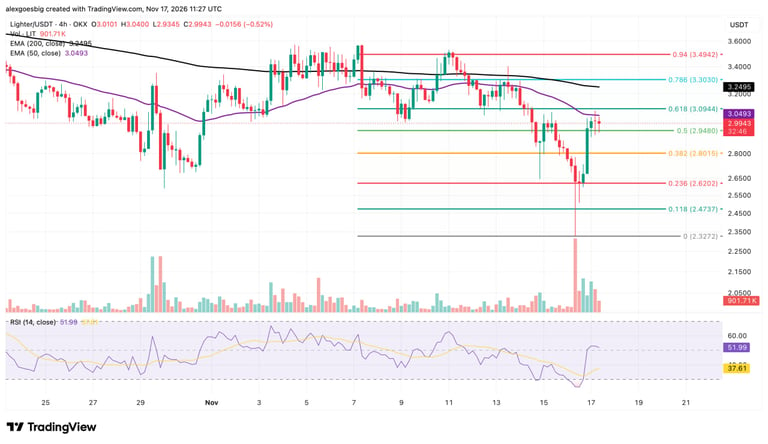

Lighter said a November 16 incident involving hijacked API keys from two market makers—not a flaw in its protocol—resulted in about $15.48 million in crypto assets being taken.
Lighter attributed the breach to unsafe external signing code that reused cryptographic nonces, allowing attackers to reconstruct API private keys from public signatures; the exchange said the keys could not directly send funds to outside parties, but could authorize transfers into public pools without an additional signature.
The reported total spans two market-maker accounts: about $10.39 million from account #714710 and a further $5.09 million attributed to account #714723, though the second account’s loss was not independently verified on-chain and Lighter did not confirm the larger estimate.
Observers traced about $10.39 million in USDC from Lighter’s L1 contract, later swapped for roughly 5,400 ETH and sent in smaller transfers; Bitquery said 1,920 ETH, worth about $3.5 million, subsequently moved through 12 wallets to Hyperliquid, where accounts bought XMR1, a token named after Monero.
Bitquery also reported a separate $6.45 million Safe-wallet theft on November 16 and a Kava-related exploit two days earlier, but cautioned that similar transaction routes into XMR1 do not establish a common attacker or a connection to Lighter’s breach.
Lighter temporarily halted withdrawals and the creation of new liquidity pools, then said a safeguard returned about 5 million USDC and withdrawals resumed; it said its protocol, contracts, infrastructure and official software kits were unaffected.
In response, Lighter required a wallet signature for API-key transfers to public pools, made API signatures non-public, and said it was adding IP allowlists and per-key permissions, including market restrictions.
At the time of the report, Lighter had not confirmed a final loss figure or provided further details about the external party, and its investigation was ongoing; it also had not explained how the key was exposed, what contract upgrades would change, or whether affected traders would be reimbursed.
LIT fell more than 10% to below $2.48 after the incident, and Upbit and Bithumb temporarily halted deposits and withdrawals; the sell-off triggered more than $3.43 million in liquidations, including over $3 million in long positions.
After Lighter reopened deposits and withdrawals, LIT rebounded nearly 14% in 24 hours to about $3.00, recovering most of its initial drop to $2.33.
Despite the rebound, LIT remained below its previous weekly level and was testing resistance at $3.05–$3.09; a four-hour close above $3.09 could bring $3.25 and $3.30 into view, while support sat near $2.95, $2.80 and $2.62.
The broader concern is that a compromised credential can cause financial harm even without withdrawal rights: valid trading authority may open unwanted positions or alter exposure, while a compromised liquidity provider could leave gaps in quotes or force hedging; any effects on Hyperliquid or its HLP would depend on the accounts’ permissions, positions, exposures and market depth, and Lighter’s incident alone does not show those effects will occur there.
Summary based on 11 sources
Get a daily email with more Crypto stories
Sources

CoinDesk • Nov 16, 2026
Lighter pauses withdrawals after a leaked API key leads to $10.4 million theft
Cointelegraph • Nov 16, 2026
Lighter pauses withdrawals after reported $10M account theft
Bitcoin News • Nov 16, 2026
Lighter Confirms Security Breach, LIT Token Dives After $15M Swiped
The Block • Nov 17, 2026
Lighter reopens withdrawals after trader's API key leak, returns about $5 million in USDC