Physical AI Market Set to Surge to $126.9 Billion as Robotics Deployments Expand
November 16, 2026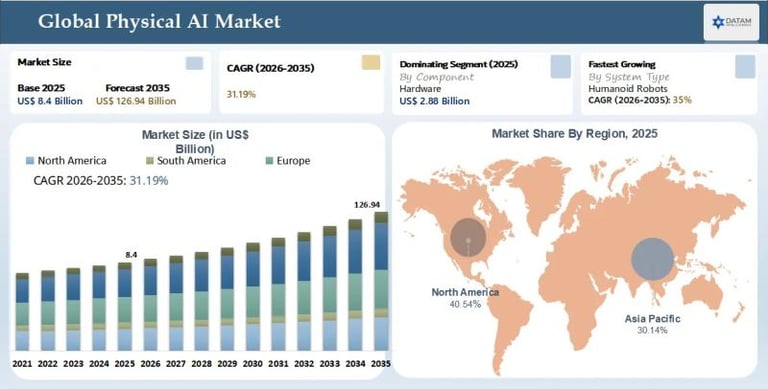

DataM Intelligence estimates the global Physical AI market was worth US$8.4 billion in 2025 and projects it will reach US$126.94 billion by 2035, with a reported 3.19% CAGR for 2026–2035.
The market is moving beyond task-specific automation toward systems that can perceive, reason, build world models and act; hardware currently generates the largest share of revenue, while software is expected to grow faster on the strength of foundation models, simulation and fleet-level intelligence.
The report breaks the market down by components, technologies, deployment models, system types, mobility, applications, end uses and sales channels, spanning North America, Asia-Pacific, Europe, and the Middle East and Africa.
In Japan, Hitachi and FANUC are developing and commercializing Physical AI for industrial robotics, with manufacturing trials and broader deployment planned from fiscal 2027; separate initiatives will use Lawson retail data to develop automation models and teach construction machinery to learn excavator operators’ skills.
Mitsubishi Electric has developed a system that enables humanoids to work with CNC machine tools, while Bitcoin Japan agreed to distribute six UBTECH robot models, including the Walker S2, alongside deployment and Robotics-as-a-Service offerings.
In the United States, Agility Robotics began trading on Nasdaq in November 2026 following a business combination and financing that generated about US$465 million; the company reported more than US$300 million in committed multi-year orders for its Digit 5 robots.
Agility Robotics and GXO Logistics also expanded plans to deploy Digit robots at additional facilities in North Carolina and Tennessee, with rollouts expected to begin in early 2027 and focus on repetitive warehouse material handling.
Other U.S. developments include FF EAI Robotics and Faraday Future launching the US$2,490 FF Nova humanoid and developer program, AMD agreeing to acquire World Labs for about US$8.2 billion to strengthen spatial-intelligence capabilities, and Boston Dynamics opening a Georgia facility to train Atlas robots for automotive manufacturing tasks.
Summary based on 1 source