U.S. Weighs Requiring Companies to Disclose Use of Chinese AI Models
November 18, 2026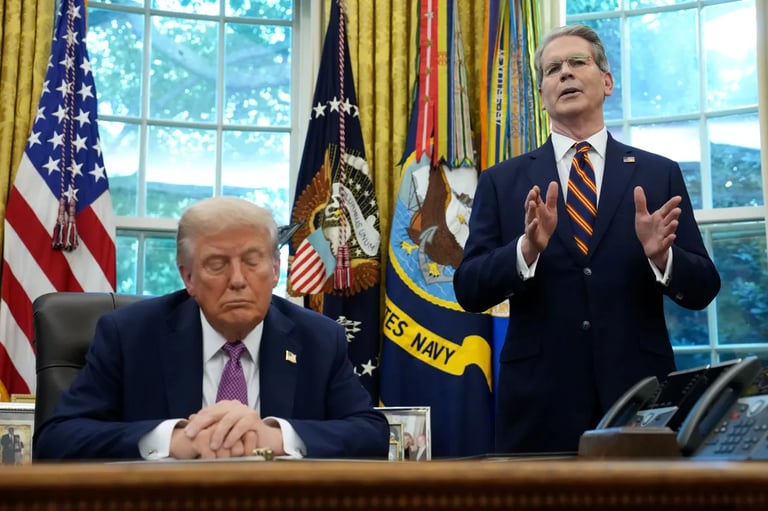

The Trump administration is considering requiring U.S. companies to publicly disclose when they use Chinese AI models, favoring a possible “name and shame” approach over new restrictions or penalties.
Treasury Department and White House Office of Science and Technology Policy officials have discussed having companies post disclosures on their websites, but it remains unclear whether the idea has support in the administration or will move to formal rulemaking.
The proposal is intended to use public scrutiny and supply-chain concerns to discourage adoption as technological competition between the United States and China grows.
Chinese models such as Alibaba’s Qwen, DeepSeek and Moonshot AI’s Kimi are attracting U.S. companies with relatively low costs and competitive performance; Kimi, DeepSeek and Qwen ranked among OpenRouter’s three most-used models by token usage in October.
Airbnb uses Alibaba’s Qwen in customer-service AI agents, while Anysphere’s Composer 2 was built on a version of Moonshot AI’s Kimi and DoorDash has routed some tasks through Kimi.
Republican Representatives Andrew Garbarino and John Moolenaar have opened an investigation into U.S. companies’ use of Chinese AI, contacting Airbnb, Anysphere, DoorDash and SpaceX.
In a letter to a company reportedly building a model on Chinese open-weight AI, the lawmakers warned that U.S. economic, government and defense systems could become dependent on models shaped by China-linked laboratories and strategic objectives.
The lawmakers also raised concerns that Chinese AI companies may use illicit methods to extract capabilities from leading U.S. models, creating risks around intellectual property, cybersecurity, provenance and supply chains.
Treasury Secretary Scott Bessent and White House science adviser Michael Kratsios have warned that distilling U.S. AI models—using one model’s outputs to train another—could expose Chinese companies to sanctions; the 2026 National Defense Authorization Act also requires specified Chinese models, including DeepSeek, to be excluded from certain government systems.
Washington remains divided over how to respond: national security advocates favor tighter controls, while other officials warn that broad restrictions could undermine U.S. innovation and harm the economy.
The U.S.-China Economic and Security Review Commission has separately recommended that public companies report Chinese-model use as a material risk in SEC filings and that nondisclosure be treated as an unfair or deceptive practice enforceable by the Federal Trade Commission; the recommendations are nonbinding.
The commission also urged restrictions on new deployments of Chinese open-weight models in sensitive settings such as critical infrastructure unless safeguards are independently evaluated.
Summary based on 16 sources
Get a daily email with more Tech stories
Sources
Yahoo News • Nov 18, 2026
Exclusive-Trump administration weighs forcing US firms to disclose Chinese AI use
The Jerusalem Post • Nov 18, 2026
Trump administration weighs forcing US companies to disclose Chinese AI model use
The Straits Times • Nov 18, 2026
Trump administration weighs forcing US firms to disclose Chinese AI use
Investing.com • Nov 18, 2026
Exclusive-Trump administration weighs forcing US firms to disclose Chinese AI use