Africa's Largest Green Copper Smelter Begins Operations, Boosts Local Processing and Sustainability
December 3, 2025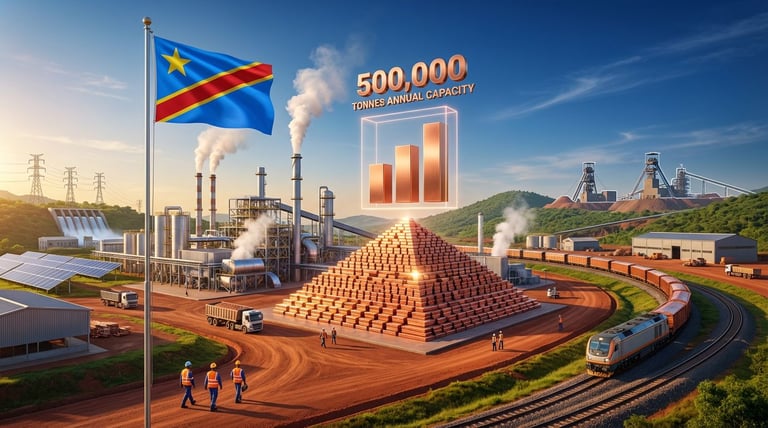

Economic and employment impacts are broad, with direct smelting jobs estimated and regional employment potentially rising to 4,000–5,500 when indirect effects are included, alongside substantial infrastructure needs for power, transport, and communications.
Infrastructure and risk management emphasize grid reliability, backup power, flood control, environmental monitoring, and active community engagement, including a traditional blessing ceremony linking cultural heritage with modern operations.
Africa’s largest green copper smelter, Kamoa-Kakula in the DRC, began heat-up in November and aims for full production by 2026, signaling a shift toward domestic, value-added copper processing in Africa.
Ivanhoe Mines commissions Africa’s largest and greenest copper smelter, underscoring a major move toward environmentally focused, high-capacity metallurgical processing on the continent.
The smelter uses direct-to-blister smelting to retain 65–75% of value locally, reduces energy use by 15–25%, and features advanced automation plus a sizable backup power system (60 MW UPS and 180 MW diesel generators.
Market and policy implications include potential green copper premiums, enhanced market access through sustainability certifications, and stronger copper supply chain resilience, though power reliability, skilled labor, environmental compliance, and export logistics pose challenges.
Renewable energy integration increases renewables from about 22% in early operations to roughly 83% with full hydro integration, lowering carbon intensity.
Regional and national ownership structures show significant government participation (about 20%), with Ivanhoe and Zijin each holding roughly 39.6%, Crystal River 0.8%, and the project aiming to cut copper concentrate transport costs by localizing processing in the Central African Copperbelt.
Power infrastructure combines 60 MW UPS, 180 MW diesel backup, and hydro input from Inga II, with plans to expand hydro capacity to 100 MW in early 2026 and to 150 MW eventually.
The project employs automated concentrate preparation, high-efficiency electrode systems, integrated acid recovery, steam generation, and energy recovery to optimize efficiency and environmental compliance.
The operation is a strategic pivot to diversify Africa’s copper value chain, reduce currency and logistics risks, and serve as a model for regional industrial development, skill transfer, and potential downstream manufacturing like wire production.
Located in Lualaba Province, the plant leverages high-grade Central African Copperbelt ore (2.5–8.0% Cu) to improve processing efficiency, with on-site processing of Phases 1–3 concentrates and toll processing at the nearby Lualaba smelter.
Summary based on 2 sources
Get a daily email with more Africa News stories
Sources

Discovery Alert • Dec 1, 2025
Africa’s Largest Greenest Copper Smelter Commences Operations in 2025
Discovery Alert • Dec 2, 2025
Ivanhoe Commissions Africa’s Largest Green Copper Smelter in 2025