New Study Unveils Logic and Reasoning Gaps in AI Language Models Like ChatGPT and Claude
February 21, 2026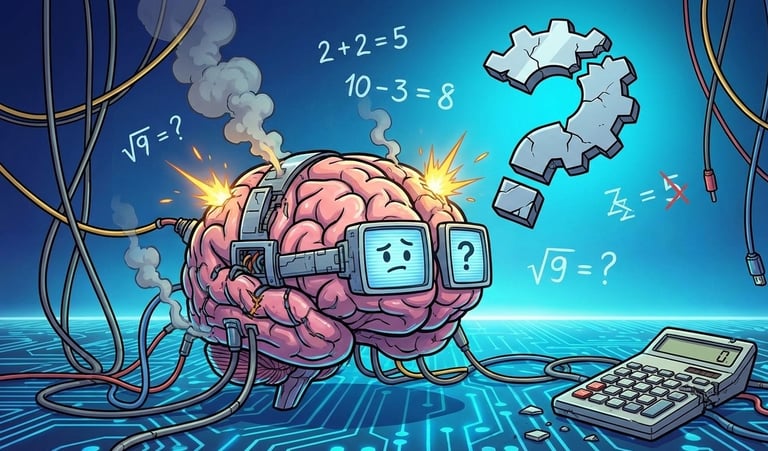

Researchers frame these vulnerabilities as a necessary step toward more reliable AI, not a verdict of failure, viewing current limits as a roadmap for improvement.
The piece clarifies what AI tools can and cannot do, urging informed and cautious use of AI.
Key findings include repeated two-hop logic failures and persistent difficulty with basic math word problems and spatial reasoning, underscoring gaps from human-like reasoning.
The article cites the arXiv preprint 2602.06176 and a related Transactions on Machine Learning Research release, plus a repository with compiled references for study.
Overall, there is cautious optimism: despite strengths, LLMs are not near artificial general intelligence, but failure analysis can guide architectural and training improvements.
They argue failures can drive progress, proposing root-cause analyses, unified failure benchmarks, failure-injection techniques, and dynamic benchmarks to spur continual resilience.
It argues LLMs function more as pattern predictors than true understanding or reasoning, lacking a human-like theory of mind or moral intuition.
A new study from Stanford, Cal Tech, and Carleton College finds that large language models like ChatGPT and Claude still struggle with basic logic and reasoning, despite impressive capabilities.
The findings span broader cognitive and physical reasoning gaps, including adapting to different prompts and maintaining coherent plans over longer tasks.
Identified weaknesses include trivial logic errors (like A=B implying B=A), biases such as overemphasizing the first item, and planning difficulties in 3D spaces when prompts vary slightly.
The paper categorizes failures into five areas—cognitive, implicit and explicit social reasoning, logic in natural language, arithmetic, and reasoning in embodied 3-D environments—highlighting memory, abstract reasoning, theory of mind, moral reasoning, planning, and multi-step reasoning gaps.
Summary based on 2 sources
Get a daily email with more AI stories
Sources


Android Headlines • Feb 20, 2026
The Logic Gap: Why Even the Top AI Models Struggle with Basic Math