MIT Study Reveals Leading AI Agent Categories, Highlights Balance of Autonomy and Oversight
February 21, 2026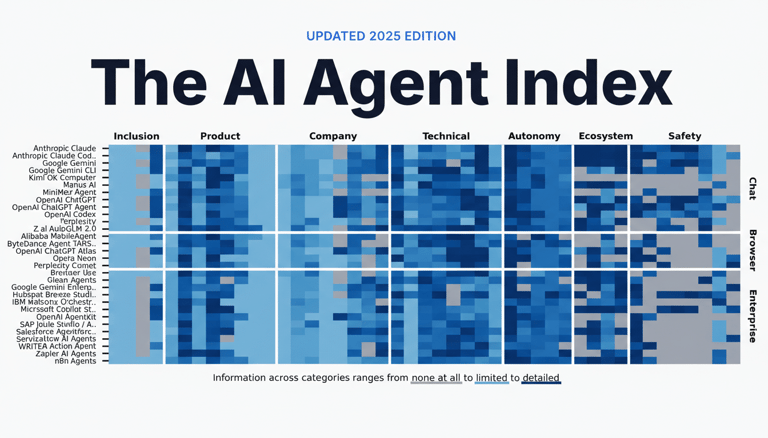

The AI agent landscape clusters into three leading categories: enterprise workflow agents that automate business tasks, chat applications with agentic tools that can perform API calls and tool use, and browser-based agents that operate directly on web pages and desktops.
Development is heavily concentrated in the US and China, reflecting broad investment in foundation models and cloud platforms and shaping how integrations, compliance defaults, and language coverage are handled.
Some agents act as developer or CLI tools and require explicit confirmation for sensitive actions, with watch modes offering real-time oversight of critical tasks.
Watch modes, explicit consent mechanisms, and oversight panes are increasingly common across agent types, helping control high-stakes actions.
Experts advise starting with low-stakes workloads and gradually increasing autonomy as guardrails and monitoring mature, with organizations expected to blend multiple agent types rather than rely on a single path.
MIT analyzes 30 leading agents from providers like Claude, Gemini, OpenAI, IBM, Microsoft, SAP, Salesforce, and more, using extensive data points to compare capabilities, interfaces, and safeguards.
The index stresses fit-for-purpose over finding one best agent, highlighting a spectrum of autonomy and use cases across categories.
Highe autonomy agents exist in enterprise contexts, including Glean, Gemini Enterprise, IBM watsonx, Copilot, n8n, and OpenAI AgentKit, capable of triggering actions with minimal human input.
Autonomy levels vary: chat-first assistants tend to have lower autonomy with more human oversight, browser-based agents carry higher autonomy and risk, and enterprise platforms span both modes with event-driven triggers and guardrails.
Value centers on research and synthesis and workflow automation, with significant demand for GUI/browser control agents that handle tasks like booking and form completion.
Top use cases include information synthesis and workflow automation across HR, sales, support, and IT, with many agents enabling GUI/browser task automation.
Browser-based agents operate on web pages and desktops, performing navigation, form filling, and transactions, but pose higher risk due to background operation and limited prompts.
Summary based on 2 sources
Get a daily email with more Tech stories
Sources

ZDNET • Feb 21, 2026
These top 30 AI agents deliver a mix of functions and autonomy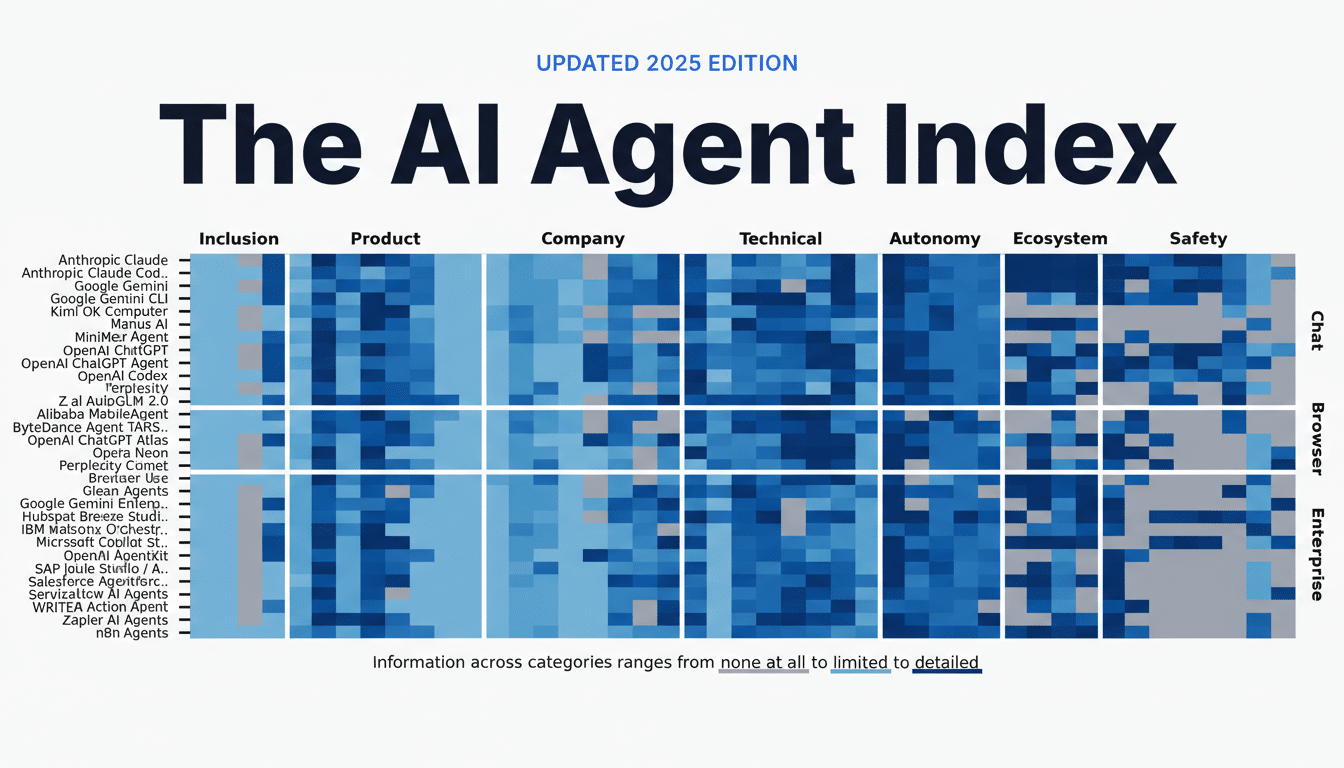
FindArticles • Feb 21, 2026
MIT Index Ranks Top 30 AI Agents By Autonomy And Use