AI Transfer Learning Promises Faster Cosmology Simulations, But Faces Negative Transfer Risks
June 11, 2026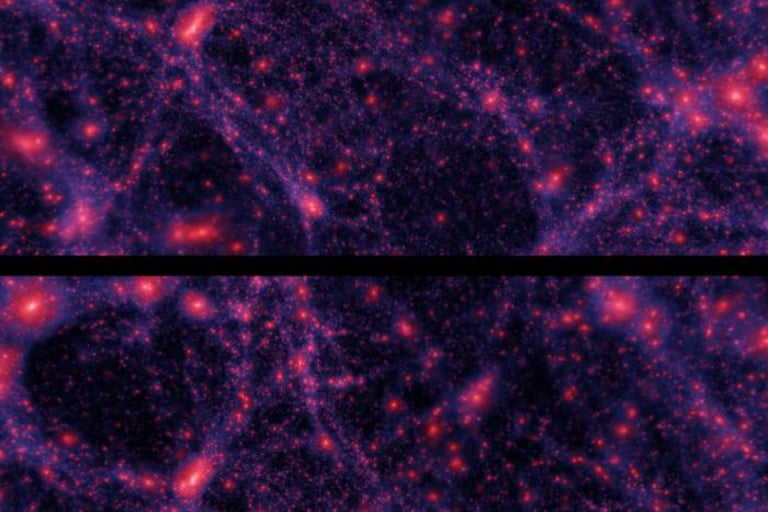


Transfer learning in AI is being explored to speed up cosmological simulations beyond the standard ΛCDM model, with the goal of accelerating the search for new physics while cutting computational costs.
However, reliance on prior knowledge can hinder discovery when different physical processes produce similar observables, risking negative transfer.
Negative transfer is a real risk, notably with massive neutrinos whose effects on cosmic structure can mimic changes in the ΛCDM parameter sigma-eight, potentially confusing AI unless it can unlearn or adjust its priors.
The framework has so far been tested on virtual universe models; more work is needed to validate robustness on real observational data and to address degeneracies in neural network learning.
The study is published in a cosmology journal and has been tested only on simulations so far; large-scale real-world validation remains to be demonstrated.
Implications call for safeguards against negative transfer as upcoming deep-space surveys will produce vast, high-precision data and could otherwise mute signs of new physics.
Degeneracies in the model mean different physical causes yield similar observables; removing small-scale data where neutrino and sigma-eight effects masquerade can help reveal the true driver.
Negative transfer is a controlled risk arising from fundamental physical degeneracies and must be mitigated as part of the transfer-learning method.
The approach targets phenomena like modified gravity, massive neutrinos, and dark energy particles, all requiring extensive simulations.
Researchers stress the need to balance pretraining with exposure to more complex models and to mitigate negative transfer to preserve sensitivity to new phenomena.
AI can accelerate cosmological exploration when used in a structured way, but human researchers must carefully interpret and monitor results to avoid misleading conclusions.
Practical takeaway: develop mechanisms to detect when to trust prior knowledge and when to set it aside to enable discovery of new physics.
Summary based on 6 sources
Get a daily email with more Tech stories
Sources

Gizmodo • Jun 11, 2026
AI Learned How the Universe Works—and That Created an Unexpected Problem for Physicists
The News International • Jun 11, 2026
Scientists say AI can find new Physics faster but not without risks
NeuroEdge • Jun 10, 2026
To Find New Physics, an AI First Has to Forget the Old Physics It Learned
ScienceDaily • Jun 11, 2026
AI could uncover new physics faster but there’s a surprising catch