World Bank's AI-Powered Initiative Enhances Global Building Energy Code Enforcement Data Accuracy and Efficiency
October 8, 2026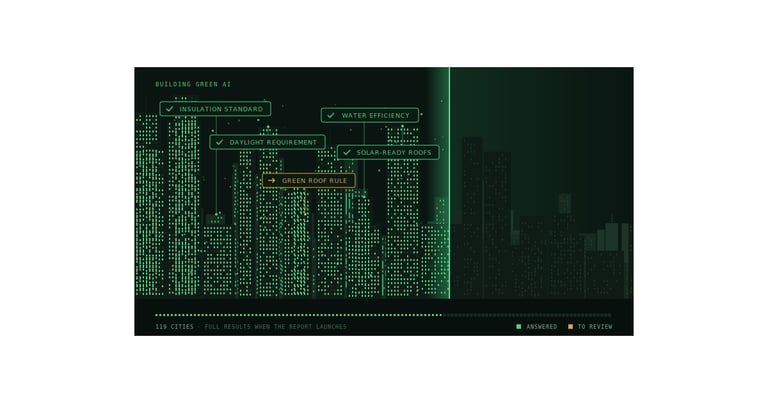

The legal data effort answers 60 questions per city using AI, anchored to official sources, with labels like “Insufficient evidence found” when evidence is weak.
The workflow employs three verification layers: automated consistency checks, Claude’s independent legal-basis review in supervised sessions, and a final team check against the underlying sources.
The World Bank Group is building Building Green, a dataset on building energy codes and enforcement, covering 119 cities across 110 economies with both legal requirements and practical enforcement data.
The Spring 2027 edition will publish each city’s legal requirements alongside expert enforcement reports, highlighting gaps between law and practice as policy questions.
Design lessons emphasize separating sourced legal answers from enforcement experience, applying multi-layer verification, and turning recurrent errors into workflow rules, with applicability to other datasets built from public records.
Initial results show over 75% accuracy across 18 of the first 21 economies, with up to 95% accuracy in the strongest yes/no or fixed-choice items.
Time and cost savings are substantial: AI-assisted work now takes roughly 4–6 hours per city, down from 2–3 days, with production costs around $27 per city (about $3,200 for 119 cities).
A benchmark dataset of 7,140 human-graded rows across 60 questions in 119 cities was created to test future automated verifiers.
Enforcement data—how codes are applied in practice—are collected from local experts via a separate questionnaire, though these answers lack official sources.
AI tools tested include OpenAI GPT-5.4 Mini for legal questions and Claude for legal-basis review; analysts perform checks with exact legal citations and source URLs for each answer.
Summary based on 1 source
Get a daily email with more AI stories
Source
World Bank Group • Oct 8, 2026
Can AI read the rules for greener buildings? We put it to work in 119 cities