31-Year-Old KLS Conjecture Solved: Breakthrough in High-Dimensional Geometry and Probability
October 21, 2026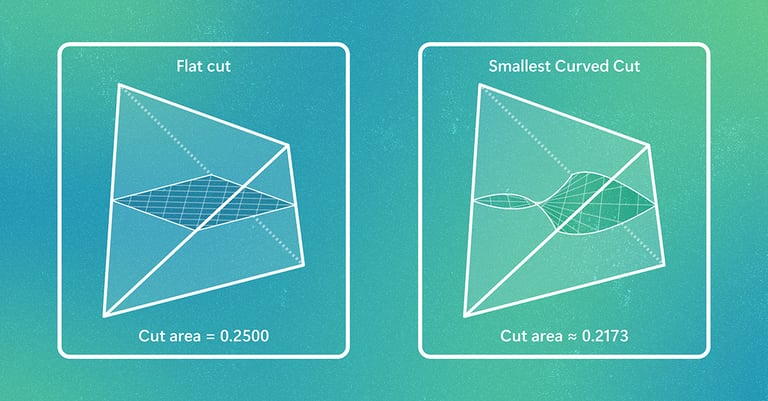

Microsoft Research announced that Xinzhi Zhang and Zhao Song proved the Kannan–Lovász–Simonovits (KLS) conjecture, resolving a 31-year open problem in high-dimensional geometry and probability.
The breakthrough shows that for a broad class of high-dimensional distributions, the best flat cut is within a universal constant of the best possible cut, independent of dimension.
AI tools aided exploration and manuscript preparation, while researchers guided direction, selected ideas, and verified the proof, described as agentic search with iterative human-assisted pruning.
Independent validation followed promptly, including full proofs by separate groups and a Lean 4 formalization, reinforcing confidence that the result reflects a genuine underlying principle.
The technical path refined a bound from July 2026, pushed dimension dependence down to an iterated logarithm, and proved accumulated errors stay bounded by a universal constant through a fully recursive refinement, completed in October 2026.
Previously, the best bound grew with dimension, with the latest prior result establishing ρ_n = O(log^{1/4} n); the new result eliminates dimension dependence entirely.
Acknowledgments credit Zhao Song and others for contributions and discussions throughout the project.
The result establishes a universal geometric principle for log-concave distributions, showing simple hyperplane cuts capture bottlenecks with a fixed factor regardless of dimension, with wide implications for statistics, optimization, algorithms, and computer science.
Independent proofs emerged in parallel: a 32-page proof by Bizeul, Klartag, and Lehec; another proof by Balasubramanian and Kasiviswanathan providing a dimension-free bound on the Poincaré constant; and a Lean 4 formalization named KLS500 achieving a dimension-free Poincaré constant bound of 500.
The paper An O(1) Bound for the KLS Constant was first submitted October 1, 2026 and revised October 4, 2026, presenting a bound that the KLS constant is at most a universal constant independent of dimension.
The conclusion emphasizes that resolving KLS strengthens the foundations of convex geometry, probability, and theoretical computer science, and demonstrates the value of combining human insight with AI in scientific discovery.
The broader consensus notes KLS as a central open problem in high-dimensional convex geometry with implications for random walks and sampling in high dimensions.
Summary based on 2 sources
Get a daily email with more AI stories
Sources

Microsoft Research • Oct 21, 2026
Solving a 31-year-old grand challenge in mathematics – the KLS conjecture
Unite.AI • Oct 21, 2026
Microsoft Researcher and Collaborator Prove 31-Year-Old KLS Conjecture