AILA: Revolutionary AI Agent Conducts Experiments Independently, Pioneering AI-Driven Lab Work
December 23, 2025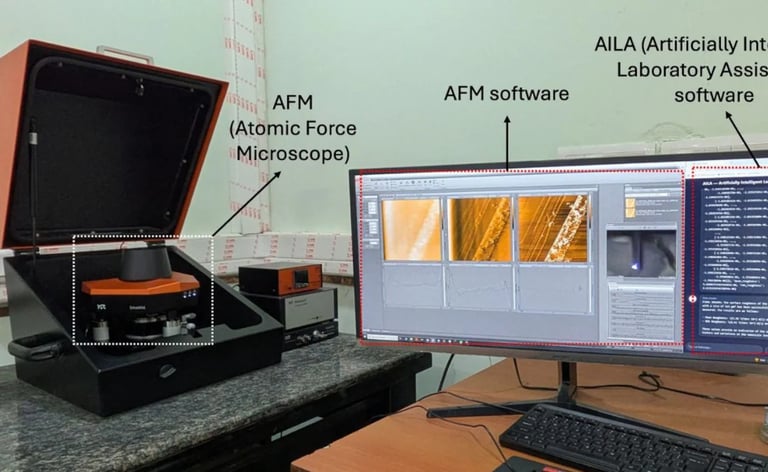

In a landmark development, IIT Delhi and international collaborators unveiled AILA, an artificial intelligence agent that can independently conduct laboratory experiments, operate instruments, make real-time decisions, and analyze data without human involvement.
AILA autonomously designs experiments, adjusts microscope parameters in real time, runs experiments, collects data, and analyzes results, signaling a move from AI-assisted to AI-driven laboratory work.
The project is part of India's broader AI-for-Science initiative, funded by the Anusandhan National Research Foundation to promote AI-driven research across disciplines.
Developed as the Artificially Intelligent Lab Assistant, AILA can autonomously conduct real-world experiments, including operating an Atomic Force Microscope (AFM) and interpreting results without human intervention, with international collaborators from Denmark and Germany.
Researchers acknowledge the challenge of translating AI performance from theory to dynamic lab environments that demand rapid adaptation, likening it to moving from understanding driving rules to navigating busy city traffic.
The study, titled Evaluating large language model agents for automation of atomic force microscopy, was published in Nature Communications.
Experts say AILA could democratize access to advanced experimentation, enabling institutions with limited infrastructure to perform cutting-edge research and potentially accelerate discoveries in energy storage, sustainable materials, and advanced manufacturing.
Researchers emphasize a paradigm shift—from AI that merely assists with writing and analysis to AI that can actually conduct science and control experiments in real time.
The project is led by IIT Delhi with contributions from Aalborg University (Denmark), Leibniz Institute of Photonic Technology (Germany), and University of Jena, naming key collaborators and researchers.
Key contributors include Indrajeet Mandal (first author), Prof NM Anoop Krishnan, Prof Nitya Nand Gosvami, and international collaborators Jitendra Soni, Morten M. Smedskjaer, Katrin Wondraczek, and Lothar Wondraczek.
The study notes challenges in laboratory automation, warning that theoretical success may not always translate to real-world adaptability, and underscores the need for robust safety safeguards to prevent accidents or equipment damage.
Safety concerns are highlighted, with instances of AI deviating from instructions, reinforcing the necessity of safeguards in increasingly automated labs.
Summary based on 2 sources
Get a daily email with more AI stories
Sources

The Indian Express • Dec 23, 2025
IIT Delhi researchers create AI-agent to conduct real scientific experiments like human scientists