OpenAI's Titan Chip Unveiled: A Game-Changer in AI Hardware, Set to Slash Costs by 90%
January 20, 2026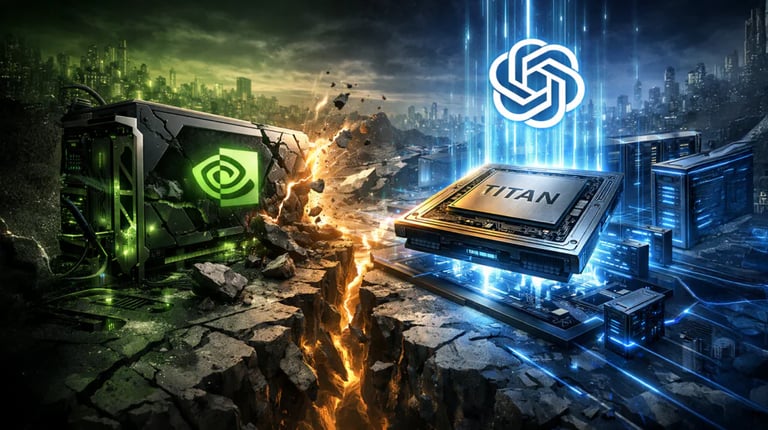

OpenAI projects total AI infrastructure spending reaching about $115 billion by 2029, with $8 billion planned for 2025, accelerating the move toward vertical integration of hardware and software.
OpenAI plans a hybrid deployment with Nvidia during the transition, then progressively decoupling compute from third-party GPUs in favor of a lower-cost, higher-efficiency path.
Mass production of Titan is planned for 2026, signaling a shift away from CUDA-based ecosystems toward an in-house, heterogeneous hardware strategy.
The market picture shows pressure on Nvidia and intensified competition among hyperscalers, with Broadcom benefiting from growing demand and TSMC capacity constraints potentially bottlenecking supply through 2026.
Conclusion: a historic shift toward owning more of the AI stack, with potential cost reductions around 90%, though technical and geopolitical risks remain a focus.
OpenAI supplements Titan with a Cerebras Systems deal for 750 megawatts of inference-focused compute, adding hardware diversification to mitigate bottlenecks and manufacturing risk.
Roadmap indicates Titan 2 on TSMC’s 1.6nm A16 process by 2027, continued emphasis on yields, exploration of edge variants, and a strong emphasis on supply-chain resilience and geopolitical risk management.
Other players such as Meta and Amazon are pursuing in-house or externally sourced AI hardware, contributing to a sector-wide shift toward diversified, internal manufacturing and architecture.
Initial projections suggest Titan could reduce inference costs by about 90% by focusing on autoregressive token generation and omitting extraneous graphics and simulation features.
OpenAI unveils Titan, a custom AI processor developed with Broadcom and built on TSMC’s 3nm process, signaling a move toward vertical integration and a fabless ASIC design aimed at lowering inference costs.
The Stargate infrastructure project with Microsoft and Oracle is tied to Titan’s role in a massive data-center expansion, aiming for a total compute commitment of 26 gigawatts and prioritizing energy efficiency.
Google pursues a dual strategy of in-house TPUs and external sales, eyeing expansion of its TPU portfolio by 2028 and targeting a large market opportunity that could reshape the competitive landscape.
Summary based on 2 sources
Get a daily email with more AI stories
Sources

FinancialContent • Jan 20, 2026
OpenAI Signals End of the âNvidia Taxâ with 2026 Launch of Custom âTitanâ Chip
Xpert.Digital • Jan 20, 2026
OpenAI breaks Nvidia's monopoly: The Titan chip and the redistribution of AI infrastructure