Google Launches Gemini Robotics-ER 1.6: A Leap in Robotic Reasoning and Safety
April 14, 2026

Google unveils Gemini Robotics-ER 1.6, an upgraded embodied reasoning model that enhances robots’ understanding of physical environments and is accessible to developers via the Gemini API and Google AI Studio.
Safety remains a core focus; ER 1.6 demonstrates safer decision-making under gripper and material constraints, with improved hazard detection in text and video scenarios and stronger adherence to Gemini safety policies.
ER 1.6 strengthens three core capabilities over ER 1.5: sharper spatial pointing, more reliable success detection across multiple camera feeds, and a new instrument-reading skill developed in partnership with Boston Dynamics.
From a business perspective, the technology opens opportunities in manufacturing and logistics, including autonomous sorting and handling in unpredictable layouts to boost efficiency and reduce labor costs.
Looking ahead, widespread adoption is anticipated by 2030, with potential healthcare and disaster-response applications, strategic partnerships with industry players, and a continued emphasis on responsible AI to manage safety and workforce impact.
Industry watchers view SMCI as an undervalued opportunity in AI hardware, while noting the current low valuation and limited insider activity.
Implementation considerations include high upfront costs around $100,000 per unit and the need for skilled technicians, with mitigations such as scalable cloud-based training to cut deployment time by up to 30%.
Technically, the upgrade employs multimodal AI processing and self-generated code to adapt across lenses and angles, tackling calibration and accuracy challenges in high-stakes settings like manufacturing plants and energy facilities.
Boston Dynamics collaboration signals industrial deployments where precision matters, with instrument-reading capability expanding use cases, though commercial-scale deployment remains to be proven.
Strategic and regulatory considerations include data privacy, edge computing to reduce latency, and compliance with frameworks such as the EU AI Act, with competition from OpenAI and Boston Dynamics and leveraging Alphabet’s data resources.
AIVI-Learning will support safety and security checks, asset monitoring, and 5S/materials management by automating inspections and improving accuracy.
Summary based on 14 sources
Get a daily email with more AI stories
Sources
Google • Apr 14, 2026
Gemini Robotics ER-1.6 enhances reasoning to help robots navigate real-world tasks.
Google DeepMind • Apr 14, 2026
Gemini Robotics-ER 1.6: Powering real-world robotics tasks through enhanced embodied reasoning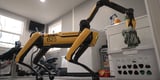
IEEE Spectrum • Apr 14, 2026
Boston Dynamics and Google DeepMind Unveil a Smarter Spot
Tribune Online • Apr 14, 2026
Google rolls out upgrade to help robots reason about physical world