Beever Atlas Revolutionizes Team Chats into Secure, Structured Knowledge Graphs for Enterprises
May 9, 2026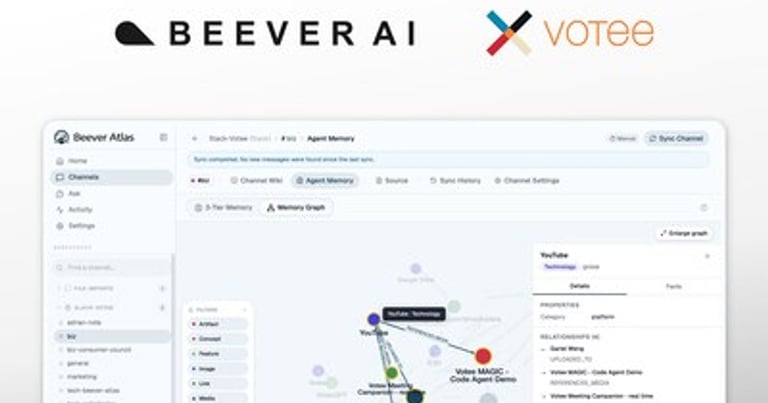

Two editions are available: an Apache 2.0 Open Source Edition for individuals and an Enterprise Edition for teams, with the latter targeting banks, government agencies, and large organizations requiring high security.
Launched by Votee AI and Beever AI, Beever Atlas is built around a structured knowledge graph and offers both Open Source and Enterprise editions designed for high-security needs.
Beever Atlas is an open-source and enterprise LLM knowledge base that transforms team chats from Telegram, Discord, Mattermost, Microsoft Teams, and Slack into a structured Neo4j knowledge graph, an auto-generated wiki, and a memory layer for AI assistants.
Beever Atlas ships with a native MCP server, enabling direct querying of the memory layer by agents like AWS Kiro, Cursor, and Qwen Code.
The platform emphasizes Sovereign AI with on-premise or private cloud deployment, zero telemetry, and data sovereignty through BYOL and encryption.
Beever Atlas is fully on-premises with Docker deployment, strong encryption, private-channel filtering, and support for local or cloud LLMs via LiteLLM.
The project bets that a structured (typed) memory provides richer queries and provenance than pure vector similarity, enabling more valuable agent memory.
The goal is to prevent knowledge loss in workplaces by cataloging conversational data into a persistent, cumulative organizational asset.
Security and sovereignty features include 100% on-premise deployment via Docker, AES-256-GCM encryption, private-channel filtering, and the option to Bring Your Own LLM (LiteLLM) to run locally or in multiple clouds.
Beever Atlas positions itself as a foundational memory backend for enterprises to avoid reliance on external AI stacks and to maintain data governance and security.
In response to calls for smarter AI memory, the project delivers a chat-native, multi-platform ingestion with a unified memory layer for text, images, voice, video, and PDFs without manual uploads.
A structured Neo4j knowledge graph maps typed relationships among people, projects, technologies, and key decisions, prioritizing structure over simple vector similarity.
Summary based on 4 sources