21st.dev's AI Agent Platform: Building a Moat with Developer Ecosystem and Deep Ops Integration
May 10, 2026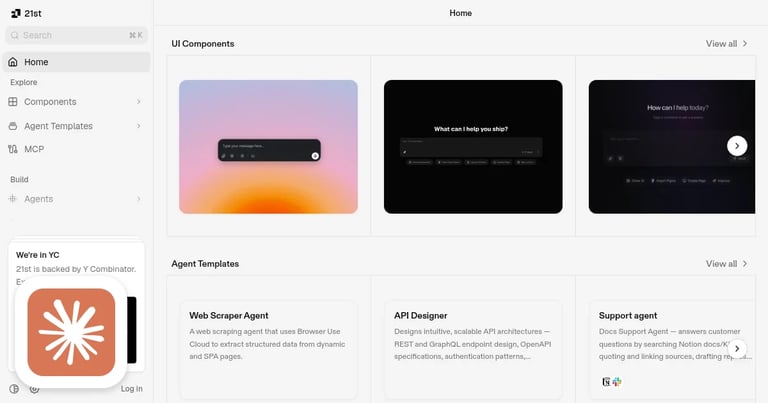

Two interlocking products drive the flywheel: a community-driven component registry (based on shadcn/ui, Tailwind CSS, and Radix UI) and the Agents SDK handling sandboxing, credentials, streaming, observability, and billing for AI agents.
Technical approach includes per-session sandboxed E2B microVMs for isolation, SSE-based real-time streaming, a network-level credential proxy to protect secrets, and comprehensive observability for debugging and billing, all supporting model-agnostic operation.
The platform remains model-agnostic, supporting Claude, OpenAI, and MCP, with neutrality treated as essential rather than a differentiator.
The Agents SDK enables teams to deploy AI agents without internal ops complexity, embracing production-grade sandboxing, credential management, streaming, observability, and billing.
While the underlying primitives are well-understood, the real barrier is distribution; cloning the tech is feasible in months, but achieving equivalent ecosystem reach is much harder.
21st.dev is building an infrastructure-focused play anchored by a large, trusted developer ecosystem and deep ops integration, betting that ecosystem-driven distribution will be the real moat in a crowded AI agent market.
Targeting development teams deploying AI agents, the registry boosts awareness while the SDK monetizes usage through hosted sandbox time, streaming throughput, and observability retention, creating a bottom-up path from discovery to production.
The big picture: 21st.dev combines a marketplace of production-ready UI components with an agent infrastructure, aiming to differentiate through an ecosystem that accelerates production adoption.
Additional implementation details feature a GitHub-backed, semantically searchable component registry and robust observability including session replay, traces, and token spend dashboards.
Replicability suggests core tech can be clone-built by a small team in months, but seeding and maintaining a 1.4 million-developer base and accumulated production experience remains the true moat.
Conclusion: ecosystem scale and founder execution are the primary competitive advantages; the foundational infrastructure can be copied, but replicating distribution and community will be the hard part.
The moat rests on three pillars: a large developer community, deep SDK-led integration that drives stickiness, and founder-level distribution that powered rapid growth to 1.4 million developers.
Summary based on 2 sources
Get a daily email with more AI stories
Sources

StartupHub.ai • May 9, 2026
Claude's Corner: 21st.dev — The NPM for Design Engineers Goes All-In on Agent Infrastructure