India Eyes Sovereign AI Systems for Defence, Balancing Innovation with Cost and Security Concerns
May 11, 2026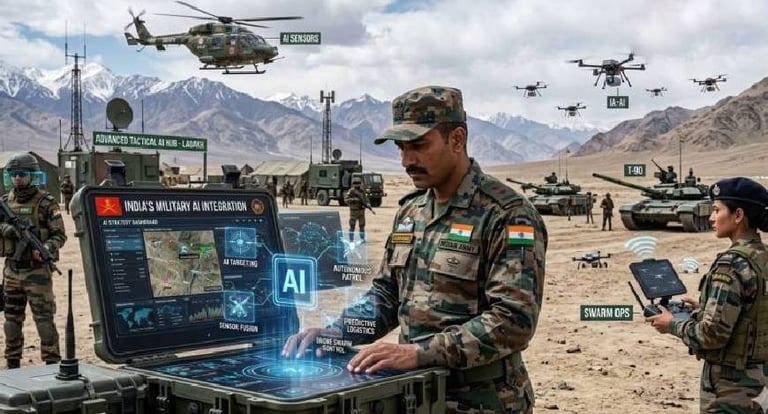

Past and current military use of AI, including cloud-based air command and control in operations and predictive tools for countering regional moves, reinforce the case for domestic AI development.
Operational AI deployment—such as cloud-enabled command-and-control during operations and predictive analytics for border tensions—signals active use alongside ongoing development.
Defence ministry is weighing cost considerations, noting that large general-purpose models require hundreds of millions in compute and data costs, while smaller, purpose-built models may be more affordable for India.
To offset costs, there is interest in government support like discounted GPU access under initiatives aimed at fostering domestic AI capabilities.
Conflicts in recent years show AI’s potential to enhance both defensive and offensive operations, influencing India’s push for indigenous, sovereign AI solutions for battlefield decision-making and cyber operations.
Examples from Iran, Ukraine, and other recent conflicts illustrate AI’s role in decision-making, surveillance, and cyber activities, informing New Delhi’s strategic direction.
The drive to reduce dependence on foreign suppliers includes developing domestic hardware capability to support AI initiatives over the long term.
India is pursuing domestically developed AI systems for defence to reduce reliance on foreign technology, with talks underway with domestic firms to integrate AI models into military capabilities while staying mindful of external expectations from allies who advocate building on American AI foundations.
India remains wary of fully relying on the US AI stack and seeks sovereignty in defence AI solutions, aligning more closely with domestic capabilities and a self-reliant AI infrastructure for national security.
Officials acknowledge that large Western AI models are costly and not always ideal for strategic sectors, favoring smaller, domestically tuned models to guide autonomous systems and intelligence fusion.
Military planners see value in deploying smaller, ground-focused AI models to support autonomous systems, intelligence fusion, surveillance, reconnaissance, and target mapping, even if large Western models are not yet replicable locally.
There is concern about hardware latency and dependence, as most high-end GPUs and related hardware are currently produced by foreign companies, prompting a push to secure domestic hardware capabilities alongside software models.
Summary based on 2 sources
Get a daily email with more AI stories
Sources
The Indian Express • May 11, 2026
After Iran, Ukraine conflicts: Govt targets homegrown AI systems for defence sector
Communications Today • May 11, 2026
SarvamAI, BharatGen in talks with defence ministry over military AI use