AI Revolutionizes Hurricane Forecasting: DeepMind Outperforms Traditional Models for 2026 Season
May 30, 2026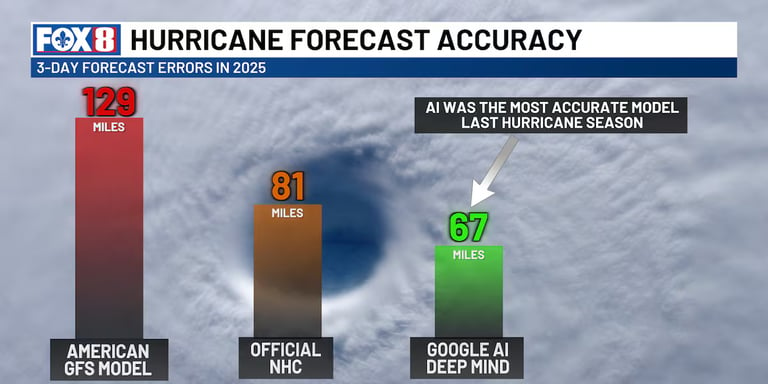

AI weather models, including Google DeepMind’s AI, are being evaluated for the 2026 hurricane season to improve forecast accuracy.
The Hurricane Center found that AI-augmented forecasts outperformed many traditional models in 2025, with DeepMind’s system showing slightly better short-range performance.
AI is increasingly integrated into hurricane forecasting, as the National Hurricane Center blends AI tools with conventional models for enhanced guidance.
Both AI and traditional systems start from a global data snapshot sourced from hurricane hunter dropsondes, satellites, balloons, and NWS data before feeding into their respective modeling pipelines.
Despite AI advances, human meteorologists remain essential to resolve data conflicts and to communicate risk and safety information to the public.
Experts say AI is faster and cheaper to run than traditional models, enabling more frequent updates and wider use alongside conventional guidance.
AI systems deliver forecasts in seconds, dramatically reducing processing time compared with physics-based models that require heavy computing.
AI models differ in methodology from traditional forecasts: they analyze vast historical data to identify patterns rather than solving live atmospheric physics equations.
AI forecasting uses neural networks trained on decades of data to identify patterns and project future conditions, instead of solving physics equations.
Future steps include improving data assimilation for AI models and continuing rigorous evaluation before broader operational use, with the NHC noting they are just beginning to explore AI’s potential.
Beyond Melissa, DeepMind and other AI models also correctly anticipated Imelda’s offshore track, showing consistency in predicting hard-right landfall exits.
AI contributes to narrowing the cone of uncertainty by enabling faster, potentially more accurate track predictions, building on improvements since storms like Katrina in 2005.
Summary based on 3 sources
Get a daily email with more AI stories
Sources
ABC11 Raleigh-Durham • May 30, 2026
How AI speed and human insight make hurricane forecasts more accurate
Sun Sentinel • May 30, 2026
How AI could help save lives this hurricane season
FOX 8 Local First • May 29, 2026
DO NOT PUBLISH: AI gives hurricane forecasters a powerful new tool