High Bandwidth Memory: The Backbone of AI and Its Potential Return to Gaming GPUs
May 31, 2026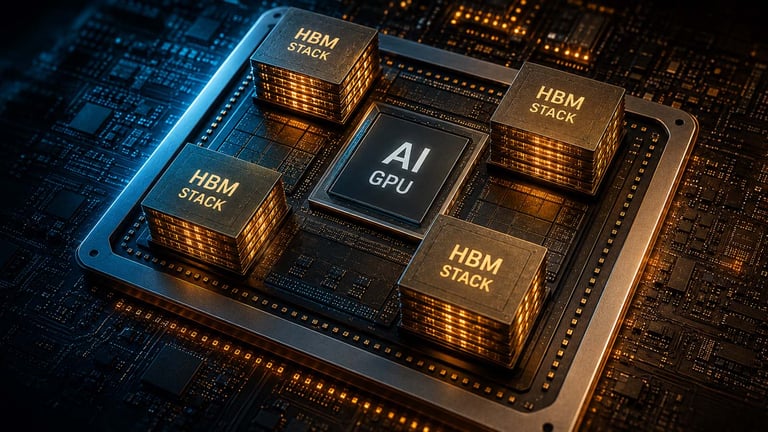

HBM has progressed through generations—from HBM to HBM4E—increasing bandwidth, density, and efficiency to support larger AI models and more demanding workloads, with a clear trajectory toward HBM4 and beyond.
Historically, HBM’s adoption in consumer GPUs has been limited by cost and packaging complexity, though there could be a gaming reemergence if bandwidth demands justify the expense.
A FAQ clarifies how HBM relates to AI performance, compares HBM with GDDR7, and discusses whether HBM could return to consumer GPUs.
HBM is shaping the AI semiconductor ecosystem as a strategic technology, drawing investment from memory manufacturers and influencing data-center and AI infrastructure design.
HBM achieves high bandwidth through vertical stacking, very wide data paths, and proximity to the processor via advanced packaging, delivering efficiency and speed gains over DDR5 and GDDR7.
HBM, standing for High Bandwidth Memory, is crucial for AI because it enables rapid data movement between memory and processors, addressing bottlenecks in modern AI workloads.
The AI memory bottleneck is growing as models and workloads demand far more data movement than traditional memory can supply, making memory bandwidth as critical as compute power.
NVIDIA and AMD rely on HBM in their AI accelerators (NVIDIA’s Hopper/Blackwell/Vera Rubin and AMD’s MI series) to provide the needed bandwidth for contemporary models.
A concise timeline traces HBM generations from its 2015 origin to HBM4E (2026+), highlighting core use cases and major advancements at each stage.
HBM remains largely enterprise-focused due to cost and manufacturing complexity, with consumer GPUs primarily using GDDR memory, though HBM has appeared in some AMD and earlier gaming GPUs.
Summary based on 1 source
Get a daily email with more AI stories
Source

ThePCEnthusiast • May 31, 2026
What Is HBM and Why Is It So Important for AI?