Aurora IIS Integrates ams OSRAM for Eye-Tracking Breakthrough in AI Glasses at AWE 2026
June 15, 2026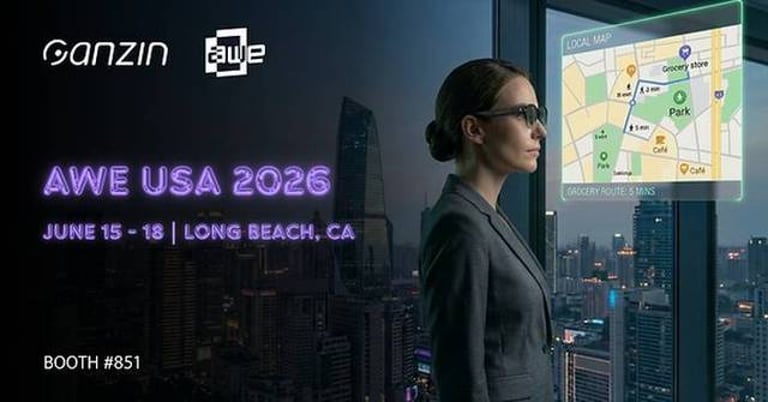

The overarching goal of the Aurora ecosystem is to make gaze tracking more practical, power-efficient, and factory-ready for AI glasses and AR headsets.
Gaze2AI 2.0 was unveiled as an evolution that merges real-time gaze attention with voice input to create attention-aware AI interactions for glasses.
Gaze2AI 2.0 combines real-time gaze attention with speech to provide context for AI assistants, enriching user interactions.
At AWE 2026, Ganzin Technology announced major ecosystem advancements that accelerate eye-tracking adoption in AI glasses through the Aurora Ecosystem, moving eye tracking toward mass production.
The new framework builds on Ganzin’s gaze-aware AI lineage, aiming to deliver attention-aware AI glasses with integrated gaze and voice capabilities.
AWE 2026 attendees can experience Aurora IIE, Gaze2AI 2.0, and the J9 AI Glasses reference design at the event.
Meeting requests for these demonstrations at AWE 2026 are being coordinated through Ganzin, highlighting hands-on access to the technology.
The demonstrations at AWE 2026 emphasize a hands-on approach to showcase the latest eye-tracking and attention-aware AI innovations.
Ganzin offers a complete eye-tracking portfolio, including Aurora-II software IP licensing, Aurora IIS turnkey NPU platform, and Aurora IIE ASIC-based ultra-low-power solution for various development stages.
Dr. Shao-Yi Chien, Ganzin’s founder and CEO, argues that attention-aware AI experiences—combining gaze, speech, and user intention—will define the future of AI glasses, and that Aurora ecosystems enable practical, power-efficient, mass-production-ready solutions.
Aurora IIE, powered by the EPU2 ASIC, delivers ultra-low-power, always-on eye tracking at up to about 120 Hz, expanding gaze-based applications in wearables, wellness, VR/MR, medical, and research.
Aurora IIS now integrates ams OSRAM infrared illumination, boosting eye safety, power efficiency, illumination consistency, and system reliability, underscoring its production-readiness for commercial AI glasses and AR devices.
Summary based on 3 sources