India's Path to AI Leadership: Balancing Innovation, Workforce Reskilling, and Ethical Governance
June 20, 2026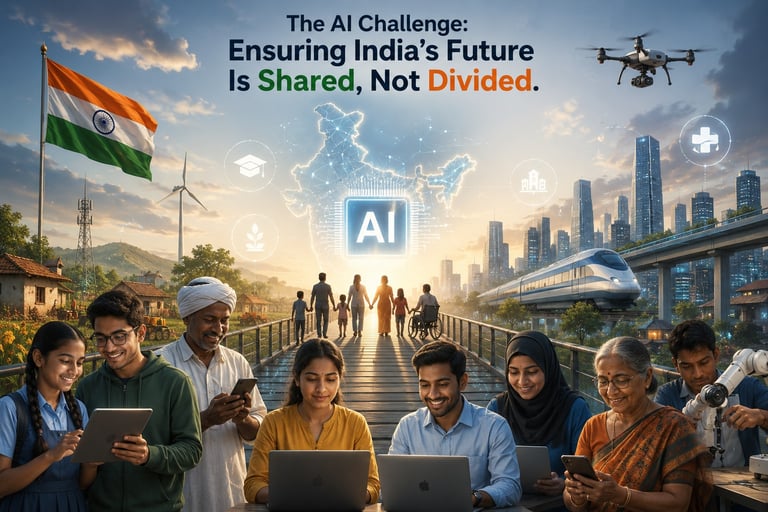

AI is already reshaping society, and India's future hinges on proactive, ethical, and inclusive leadership to realize this defining national opportunity.
Economic and societal benefits of AI must be weighed against employment disruption, underscoring the importance of reskilling and preparing the workforce for AI-centric roles.
International cooperation and governance are crucial, with India urged to participate in global AI standards and ethics discussions to shape responsible development.
By 2030, AI will touch nearly every aspect of Indian life—from learning and work to public services and business decisions—while the US and China lead the global race, creating both opportunity and competition for India.
India’s large, young workforce faces disruption from automation, particularly in informal and low-skill sectors, making a proactive AI strategy essential to avoid rising unemployment.
India has strong assets—robust tech ecosystems, engineering talent, a startup culture, and scalable digital public infrastructure—that can enable it to become an AI leader rather than merely a user of foreign technology.
India’s AI leadership advantages include a large, youthful population, expanding digital infrastructure, strong IT expertise, widespread smartphone and internet use, and a thriving startup scene under initiatives like Digital India.
There is a clear need for human–AI collaboration in laboratory medicine to improve data processing, diagnostic accuracy, and clinical decision-making.
A balanced, state-led approach combining vision, leadership, and inclusive development is required to ensure AI benefits spread widely and do not widen inequality.
India faces a core challenge in education reform: shifting from an exam-oriented, rote-focused system to nurture creativity, critical thinking, and complex problem-solving for an AI era.
The rapid rise of generative AI brings risks such as deepfakes and misinformation, making media literacy and strong governance essential.
A comprehensive national strategy is needed: scale up skills development (digital literacy, AI, ML, data science, cybersecurity) while building soft skills; support SME innovation with incentives, affordable infrastructure, and targeted training; establish ethical and regulatory guardrails to address privacy, bias, and accountability; deploy AI to advance inclusive development in healthcare, agriculture, education, and public services.
Summary based on 2 sources
Get a daily email with more AI stories
Sources

Kashmir Reader • Jun 20, 2026
Artificial Intelligence: India’s Defining Opportunity In The 21st Century
IndiaTomorrow • Jun 20, 2026
The AI Challenge: Ensuring India’s Future Is Shared, Not Divided