AI Revolutionizes Healthcare: Enhancing Patient Care and Hospital Efficiency with Smart Technology
June 26, 2026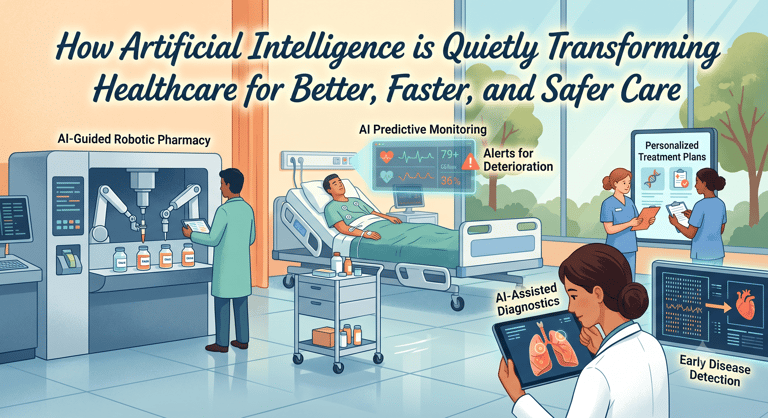

AI is transforming healthcare by improving disease detection, treatment planning, hospital operations, and overall patient care, while also making hospitals more efficient as AI automates scheduling, billing, record management, and insurance processing so clinicians can focus more on patients.
AI integrates sleep, stress, activity, and nutrition data to provide personalized health guidance rather than generic advice.
Continuous health monitoring through wearables and sensors enables at-home tracking of vitals with real-time alerts to providers, benefiting chronic patients and expanding care beyond the hospital.
Real-time health analytics are gaining traction, with roughly six in ten users engaging with generative AI for wellness in 2026.
Future health intelligence will connect emotional states, recovery cycles, and long-term energy trends to real-time outcomes, guiding proactive decisions rather than reactive care.
AI assists clinicians by analyzing patient data against global research to offer evidence-based recommendations, supporting diagnosis and treatment planning in complex cases.
AI supports prevention by detecting early signs of chronic diseases from health records and real-time data, enabling earlier interventions to reduce hospital visits.
The overarching arc is AI-enabled health management moving from guesswork to continuous insight, empowering individuals to act on their body's signals.
Trust, privacy, accuracy, and user control are critical for adoption, with transparency and human context guiding decisions in AI-enabled care.
AI-powered virtual assistants provide 24/7 health support, including reminders, basic questions, appointment scheduling, and guidance, improving accessibility.
Digital health assistants and FDA-cleared tools illustrate deep integration, adjusting care between visits and embedding AI more fully into workflows.
AI enables earlier and smarter diagnosis through analysis of X-rays, MRIs, and CT scans, acting as a second set of eyes to support clinicians in identifying cancers and other conditions.
Summary based on 3 sources
Get a daily email with more AI stories
Sources

Yonkers Times • Jun 26, 2026
How AI Is Changing the Way People Manage Their Health AI Care Shift
Business News This Week • Jun 26, 2026
How Artificial Intelligence is Quietly Transforming Healthcare for Better, Faster, and Safer Care
Business News Week - Only Business News • Jun 26, 2026
How Artificial Intelligence is Quietly Transforming Healthcare for Better, Faster, and Safer Care - Business News Week