India Launches AI-Driven Audit Portal to Revolutionize Rural Development Oversight
June 28, 2026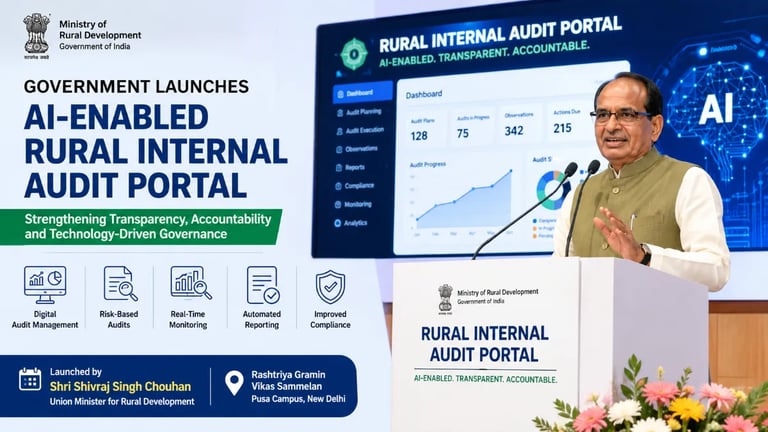

A first-of-its-kind unified digital Portal for end-to-end internal audits, covering risk-based and compliance audits, has been developed by the Office of the Chief Controller of Accounts and NIC with an AI-ready architecture.
The initiative reflects a broader digital governance push to cut manual processes and boost efficiency in rural development oversight.
Core modules include audit planning, engagement approvals, audit observations, action taken reports, para settlements, and archival of records, enabling real-time monitoring and stronger compliance management.
The platform features a modern, scalable technical architecture aligned with GoI digital standards, supported by NIC, with Git-based version control, CI/CD, environment separation, RBAC, automated security, audit logging, backups, disaster recovery, and planned AI/ML-driven risk assessment and decision support.
Pilot operations started in Chandauli district, Uttar Pradesh on 1 April 2025, with core modules fully operational by October 2025 and gradual adoption across programs.
The Chandauli pilot demonstrated successful implementation, leading to phased expansion and full operation of major modules by October 2025.
In-principle approval from the Controller General of Accounts signals the model could become a national template for financial oversight, expanding AI-driven accountability across government processes.
A geospatial Map View module helps identify unevaluated audit units, enabling targeted resource deployment and risk-based prioritization.
The launch coincided with a two-day national rural development conference in Delhi, gathering Rural Development Ministers, senior officials, and policy experts.
The initiative is framed as a model for digital public financial management in India, with a Road Ahead that envisions deeper AI integration, risk scoring, predictive analytics, and enhanced management dashboards.
Security and architecture emphasize RBAC, secure API integrations, centralized monitoring, automated exception handling, audit logging, daily backups, disaster recovery, and CI/CD workflows in collaboration with NIC.
Analytical dashboards enhance identification of implementation risks and monitoring of programme performance.
Summary based on 13 sources
Get a daily email with more Tech stories
Sources

Press Information Bureau • Jun 28, 2026
Union Minister for Rural Development Shri Shivraj Singh Chouhan Launches AI-Enabled 'Rural Internal Audit Portal' at “Rashtriya Gramin Vikas Sammelan”
Press Information Bureau • Jun 28, 2026
Union Minister for Rural Development Shri Shivraj Singh Chouhan Launches AI-Enabled 'Rural Internal Audit Portal' at “Rashtriya Gramin Vikas Sammelan”
Press Information Bureau • Jun 28, 2026
Union Minister for Rural Development Shri Shivraj Singh Chouhan Launches AI-Enabled 'Rural Internal Audit Portal' at “Rashtriya Gramin Vikas Sammelan”
Swarajyamag • Jun 28, 2026
Centre Launches AI-Powered Portal To Modernise Rural Development Audits