Generative AI in HR Market to Surge, Reaching $1.7 Billion by 2030
July 10, 2026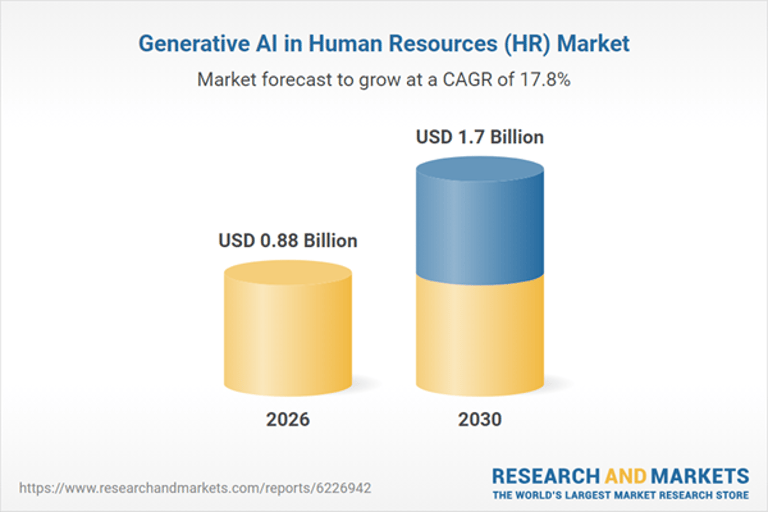

The Generative AI in HR market is projected to grow from about $0.75 billion in 2025 to $0.88 billion in 2026, a rapid 18.1% CAGR, and to reach roughly $1.7 billion by 2030 with a 17.8% CAGR.
Growth is driven by AI adoption in HR management software, AI-driven recruiting, a focus on employee retention, expanding online recruitment platforms, and automation of HR processes.
Key applications include recruiting, onboarding, and performance management, with regional analyses and a look at macro factors such as tariffs, trade, and geopolitical influences.
Industry trends emphasize automation, employee engagement chatbots, virtual reality training, and strong growth in the Asia-Pacific region.
Strategic moves include acquisitions and investments, such as Apax Funds’ 2024 acquisition of Zellis Group to bolster product portfolios and technology, with Zellis offering generative AI-powered chat interfaces.
The report covers market attributes, segmentation, regional breakdowns, TAM, attractiveness, competitive dynamics, and trends across technologies (ML, NLP, DL, CV, RPA) and deployment models (cloud vs. on-premise.
Leading players include IBM, Oracle, SAP, Workday, with North America leading activity in 2025 and Asia-Pacific expected to be fastest-growing; tariffs may raise costs but spur local innovation.
Behemoth firms are developing proprietary AI for recruitment and workforce insights, such as Beamery’s TalentGPT, which integrates GPT-4 for personalized job content and adaptive HR processes.
Upcoming trends point to AI-driven talent acquisition, automated resume screening, predictive retention models, AI-powered performance management, and chatbot engagement, with VR training and RPA for payroll and compliance.
EU enterprise AI usage rose from 8% in 2023 to 13.5% in 2024, signaling accelerating adoption across Europe.
Automation demand remains a key growth driver as AI expands HR professionals’ ability to focus on strategic tasks, with EU adoption data underscoring broader momentum.
Automation is a core driver for efficiency, reducing costs and increasing accuracy in HR tasks like candidate screening and job description creation.
Summary based on 2 sources
Get a daily email with more AI stories
Sources
Yahoo! Finance • Jul 10, 2026
Generative AI in HR Market Set to Hit $1.7 Billion by 2030 with 17.8% CAGR Growth
GlobeNewswire • Jul 10, 2026
Generative AI in HR Market Set to Hit $1.7 Billion by 2030 with 17.8% CAGR Growth