Rise of Lifelike Humanoid Companions: UBTech's U1 Leads Emotional Robotics Revolution
July 16, 2026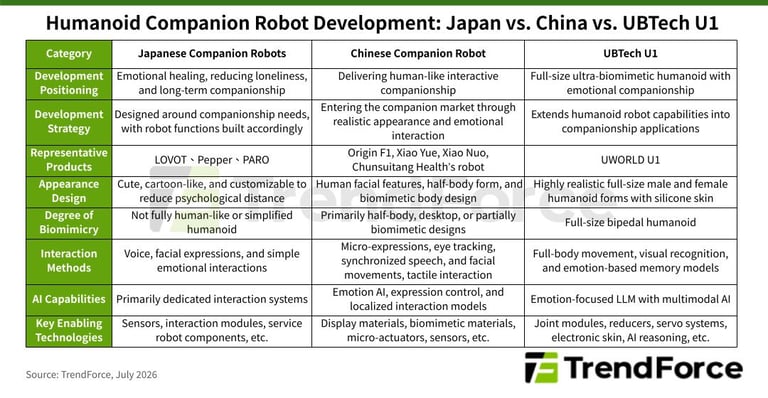

The broader 'companionship economy' shapes demand for emotional and social robot capabilities in response to demographic and lifestyle shifts.
The market has shifted from elderly care and therapy to highly human-like interaction and emotional companionship, with UBTech’s U1 symbolizing a new era of lifelike humanoid companions.
Across regions, design philosophy diverges: Japan emphasizes affinity and comforting, non-threatening appearances, while Chinese developers push for more lifelike forms and biomimetic interaction.
Notable examples include UBTech’s U1 with silicone skin, 88 degrees of freedom, and emotion-focused AI, alongside softer or more lifelike companions from Noetix Robotics, Chunshuitang Health, GROOVE X, and AIST’s PARO.
The robotics supply chain is expanding to support consumer demand for companionship, with growing emphasis on integrated hardware, AI, and content ecosystems for frequent user interaction.
The U1 launch signals a shift from industrial to consumer electronics, opening opportunities across hardware, AI models, ecosystems, and content services.
Key challenges include battery life, naturalness of emotional interactions, long-term memory and personality consistency, functional safety, privacy, and balancing capabilities with pricing.
China is pursuing more lifelike, biomimetic designs and natural interactions, yet keeps companionship as the core function.
Japan’s early leadership favored non-productive, therapeutic robots that prioritize affinity and emotional support over realism.
Expect rising demand for high-fidelity synthetic materials, multimodal sensors, micro-expression actuators, emotion AI, and on-device AI inference alongside traditional robotics hardware.
TrendForce projects the humanoid companion robot market to reach about US$1.1 billion by 2030, driven by aging populations, fewer births, and more single-person households.
Market adoption hinges on sustaining demand beyond early adopters; UBTech reportedly secured tens of thousands of orders for U1, but long-term demand remains uncertain.
Summary based on 3 sources