China's AI Revolutionizes Tourism: Robotic Guides and Smart Tech Enhance Visitor Experiences
August 3, 2026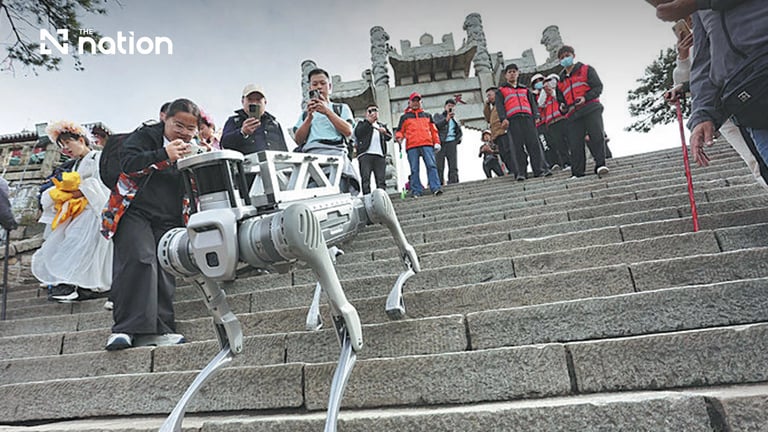

Other scenic destinations are adopting similar AI-enabled tools, such as AI travel assistants, climbing exoskeletons at Mount Huangshan, and biomimetic robotic fish in West Lake to monitor ecological conditions.
China’s AI Plus Initiative aims for widespread AI adoption across six areas, including tourism, by 2027, with Mount Huangshan and West Lake in Hangzhou deploying AI-driven tourism technologies to enhance visitor experiences.
Each robot-assisted trip carries 30 to 45 kilograms, roughly the load of a human porter, with quick battery swaps enabling all-day operation and serving as a visible tourist attraction.
A robotic dog is now part of Mount Tai’s workforce, carrying supplies uphill and hauling waste downhill to support tourism and environmental efforts and tackle the area’s waste-management challenges.
This trend reflects AI’s broader move from labs to practical, everyday use in China’s tourism sector, boosting efficiency, reducing worker strain, and enabling real-time environmental monitoring.
Since its introduction, the robotic dog has become a tourist draw, with visitors photographing it and showing interest in future upgrades.
Mount Tai’s Smart Mount Tai initiative includes AI-powered climbing exoskeletons and a digital transformation leveraging AI, IoT, cloud computing, and VR/AR for intelligent management and smart tourism services.
Overall, these developments illustrate AI moving from labs to real-world applications in China’s tourism industry, transforming operations and visitor experiences.
The robot can carry up to 120 kilograms, runs four to six hours per charge, and negotiates slopes up to 45 degrees using high-resolution cameras, LiDAR, and multiple sensors to detect obstacles.
Summary based on 2 sources
Get a daily email with more AI stories
Sources
China Daily • Aug 3, 2026
China's scenic peaks welcome a new robotic workforce
China Daily • Aug 3, 2026
China's scenic peaks welcome a new robotic workforce