Liquid Cooling Revolutionizes AI Infrastructure: AMD and NVIDIA Lead Industry Shift
August 17, 2026

TrendForce notes that cloud service providers, including Chinese operators, are upgrading AI data center architectures, aligning with AMD’s Helios and MI450/MI500 line as liquid cooling gains traction.
Institutional investors adjusted AI holdings in the second quarter, with notable moves among NVIDIA, AMD, and Broadcom, while adding SpaceX and Cerebras.
Cooling expansions extend beyond GPUs to include NICs, busbars, transceivers, and other rack components as thermal demands rise.
The push for higher compute density and tens to hundreds of kilowatts per rack makes cooling and thermal management a strategic priority.
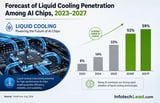
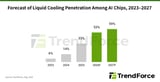
Liquid cooling is becoming standard for high-end AI infrastructure, with adoption among AI chips projected to reach about 60% by 2027, up from 53% in 2026.
AMD is expanding its AI strategy with the Helios rack-scale solution and continues developing its MI450 and MI500 platforms to compete with NVIDIA, with large-scale shipments anticipated in 2027.
Dell PowerCool enables up to fourfold higher GPU density and up to 160 kW per rack via rear-door heat exchangers, cutting cooling energy use by as much as 74%.
NVIDIA faced a Rubin heat spreader design decision, moving from a two-piece plan to a one-piece design due to substrate warpage, with Jentech remaining the sole Rubin spreader supplier.
Microsoft is deploying zonal and direct liquid cooling for NVIDIA GB300 NVL72 systems, achieving roughly 136 kW per rack.
Liquid cooling systems use cold plates, manifolds, and CDUs, with NVIDIA’s Vera Rubin platform expanding to a fanless all-liquid-cooled architecture and adding components like CX9 cards and power boards.
Major cold-plate suppliers include Cooler Master, AVC, BOYD, and Auras, with AVC planning Rubin cold-plates shipments and participation in AI ASIC supply chains for AWS, Google, Meta, and OpenAI.
Google leads in liquid cooling adoption, applying it to more than 80% of its AI servers and expanding from server to rack-scale cooling as TPU power grows, while NVIDIA and AMD drive broader industry shift toward Vera Rubin and related solutions.
Summary based on 4 sources
Get a daily email with more AI stories
Sources
InfotechLead • Aug 17, 2026
AI Data Center Liquid Cooling Adoption to Hit 53% in 2026 as NVIDIA, AMD, Google Drive Demand

Communications Today • Aug 17, 2026
Rising AI chip heat drives rapid adoption of liquid cooling solutions