Physical Intelligence's Pi-Zero Revolutionizes Robotics with $1.1B Funding and Open-Source AI Model
August 17, 2026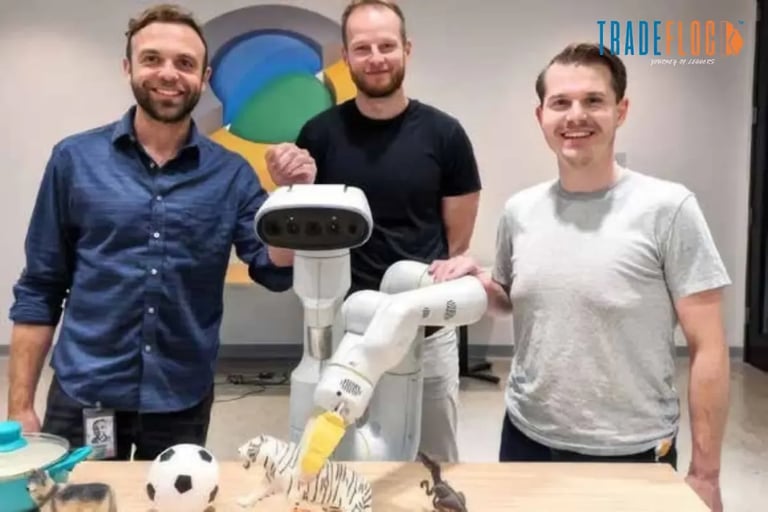

Physical Intelligence aims to build a universal AI brain for robots with the Pi-Zero model, positioned as a general-purpose foundation for robotics.
PI has raised about $1.1 billion in two years, including a $400 million Series A in late 2024 at a $2.4 billion valuation and a $600 million Series B in late 2025 at a $5.6 billion valuation, with investors such as OpenAI, CapitalG, NVIDIA, and Sequoia.
The physical AI market for robotics was $8.6 billion in 2025, with projections reaching $117.4 billion by 2034; deployment costs have fallen about 35% since 2021 and ROI timelines have shortened to roughly 18–24 months.
Pi-Zero’s code was open-sourced in early 2025 as a reference architecture; by mid-2025 Pi-0.5 demonstrated open-world generalization, Pi-0.6 introduced RECAP for demonstration, correction, and self-improvement, and Pi-0.7 in 2026 enabled zero-shot learning for unseen tasks.
The competition includes Figure AI and Google DeepMind’s robotics efforts, underscoring a race to own the intelligence layer of robotics beyond hardware.
Pi-Zero is a 3-billion-parameter transformer built on Google’s PaliGemma vision-language model, trained on more than 10,000 hours of real-world robot data across seven platforms and 68 tasks.
PI was founded in 2024 by prominent AI/robotics researchers, including CEO Karol Hausman, Chief Scientist Sergey Levine, Chelsea Finn, and VP of Engineering Brian Ichter, all with strong academic and industry pedigrees.
FAQ material outlines PI’s goals, founders’ credentials, knowledge of Pi-Zero’s architecture, and how PI differentiates itself from traditional robotics through zero-shot learning and rapid R&D execution.
Pi-Zero accepts plain-language instructions and converts them into precise motor commands across robot systems, enabling real-time task execution without retraining for each task.
The “one brain for every machine” vision advocates a single scalable AI system capable of controlling multiple robot types and tasks, with potential to transform humanoid and industrial robotics markets.
Summary based on 1 source
Get a daily email with more AI stories
Source
TradeFlock • Aug 17, 2026
Learn How Physical Intelligence’s π0 Model Powers Robotics