AIbranch Revolutionizes AI Conversations with Navigable Graph, Cross-Provider Integration
August 30, 2026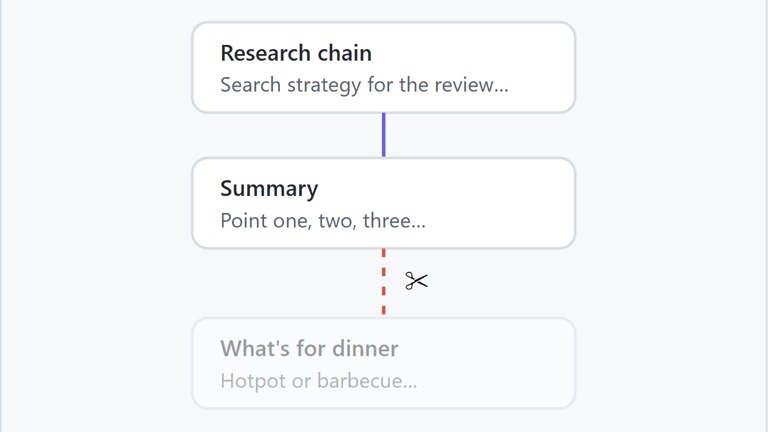

AIbranch presents a navigable conversation graph where branching and shared tool usage occur across providers, breaking free from isolated, per-thread interfaces.
Conversations are reframed as a branching tree rather than a linear thread, enabling parallel exploration and cross-provider handoffs without losing context.
The release is supported by Japan’s MEXT, with plans to expand hub-level skills, widen the provider catalog, and potentially evolve toward a directed acyclic graph for turns.
History management includes configurable summarization to compress older turns for new model context, balancing fidelity and cost with adjustable thresholds.
The approach aims to improve reproducibility by clarifying the context used for prompts and aids debugging by filtering out irrelevant or incorrect information from the graph.
Project hosted on GitHub (chenxiachan/thoughtdag) with a dedicated project page for easy access and collaboration.
Tool integration is centralized in a hub via the Model Context Protocol, enabling uniform tool use across configured models and user-registered tool servers.
Installers are available for Windows, macOS, and Linux, signaling broad cross-platform support.
Wires on the graph represent relationships between information pieces, making context visible to the model and showing what it sees, why, and what was deleted.
Security and privacy analyses show providers receive only current prompts and carried-over context, with potential gaps in audit logging, per-tool rate limits, content inspection, and URL allow-lists.
AIbranch is presented as both a research contribution and a usable platform, with code under Apache 2.0 and a citable Zenodo archive.
The main idea is to treat conversation history and documents as graph nodes, allowing pruning, merging, and rearranging to influence AI outputs.
Summary based on 2 sources
Get a daily email with more AI stories
Sources
GIGAZINE • Aug 30, 2026
ThoughtDAG is a free tool that transforms AI chat into a network of editable nodes.
BIOENGINEER.ORG • Aug 30, 2026
AIbranch platform lets users branch conversations across multiple LLMs