Humanoid Robots Dazzle at Beijing Games, Highlighting Rapid Progress and Real-World Challenges
August 30, 2026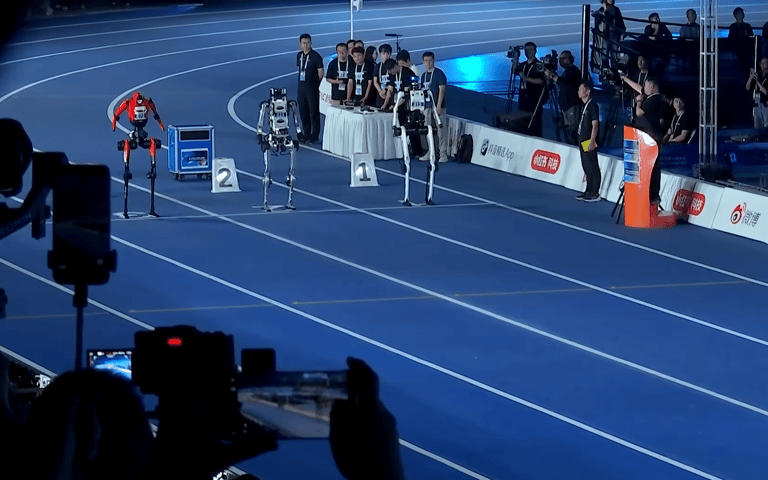


In Beijing, humanoid robots wow crowds at the World Humanoid Robot Games, with some sprinting and high-jumping performances approaching human records and signaling rapid progress in robotics.
The project is framed as a route to broader industrial innovation, with ongoing collaboration to enhance uplink capabilities, spectrum coordination, and multimodal device-to-cloud service assurance.
The event showcased a wide slate of disciplines—from free combat and table tennis to 400m and 1500m races, tug-of-war, dancing, and cheerleading finals—across multiple August 2026 dates.
A notable caveat came as a robot crashed into a padded wall at the end of a race, highlighting ongoing challenges in deceleration, stopping, and safety, while experts say future gains will come from better turning and decision-making as much as speed.
Beyond feats, the narrative emphasizes turning core technologies into scalable industry solutions and shaping global rule-making, not just piling up patents or standards.
Industry deployment hinges on common interfaces and safety standards, with concerns about reflections, dust, durability, heat management, and component life under continuous operation.
The draft outlines practical deployment hurdles—dust, reflections, heat, durability, and long-duration operation—underscoring the need for robust safety and usable interfaces.
Experts advise brokers to probe clients on hardware origin, FCC eligibility, liability coverage for software-driven incidents, indemnity terms, worker impact from automation, and accessibility of device data for claims handling.
Industry outlook anticipates consolidation around 2026–2027, with subsidies fading and viable business models emerging as investors seek demonstrable value.
NXP argues the sweet spot for physical AI is solving topology discovery, actuator safety, and secure networking, rather than chasing raw AI benchmark speeds, with distributed nervous systems as the profitable path.
Investors like Kang Yu stress long-term foundational R&D across hardware, materials, embodied-intelligence models, computing, and data infrastructure over hype.
The approach unifies visual perception, state estimation, bipedal locomotion, and physical interaction into an end-to-end policy designed to operate under real-world noise, delay, and occlusion.
Summary based on 152 sources
Get a daily email with more World News stories
Sources
Ai-Ai-OH • Aug 27, 2026
Malfunctions Worth Gold at the Robot Olympics
Yahoo! Finance • Aug 25, 2026
9.32 Seconds: TianGong Ultra Surpasses the Human World Record in the 100-meter Race!
Yahoo! Finance • Aug 21, 2026
Booster Robotics Powers Science Robotics Research Article on Vision-Driven Humanoid Soccer Skills
Ars Technica • Aug 25, 2026
World humanoid robot games show runners breaking records, bursting into flames