Tackling Data Drift: Ensuring ML Models Thrive Beyond Development with Robust Strategies
September 7, 2026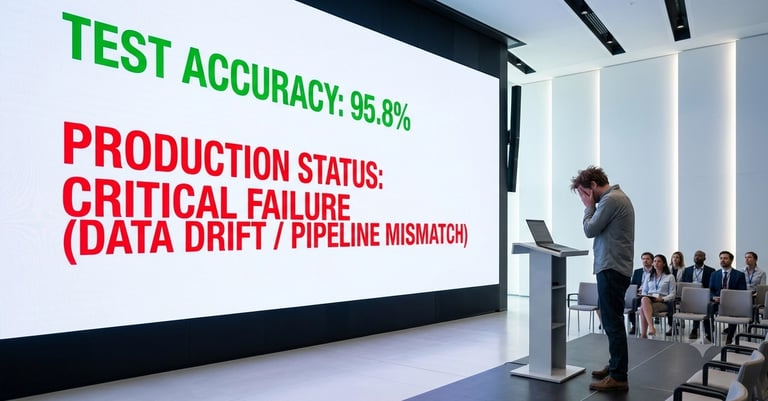

A model can achieve high accuracy in development but fail in production due to data drift, test data that is too similar to training data, and mismatches between preprocessing in training versus production.
Big-picture reality: Production success hinges on addressing data drift, robust evaluation strategies, preprocessing consistency, changing targets, and solid system design, not just model accuracy.
Evaluation may overstate real-world performance when test data closely mirrors training data, especially for time-dependent problems; consider temporal splits to better reflect production scenarios.
Preprocessing differences between training and production can shift input distributions; implement pipelines to maintain consistency.
References from DataEval on Distribution Shift and IBM guidance on monitoring ML provide context for these challenges.
Target labels can change over time (concept drift), which changes the problem the model is solving.
Production inputs may differ from training data, causing data drift or distribution shift when the model is deployed.
Intro takeaway: A model’s production performance depends on real-world data and system factors, not just development accuracy.
Summary based on 1 source
Get a daily email with more Tech stories
Source

DEV Community • Sep 7, 2026
Why Your Machine Learning Model Performs Well but Fails in Production