KAIST and Meta Unveil Revolutionary AI Data Center Design Enhancing Efficiency and Scalability
September 9, 2026

KAIST and Meta, with Panmnesia, are proposing a next-generation AI data center architecture that treats the entire facility as a single, coordinated computing resource by interconnecting CPUs, AI accelerators, and memory across the data center using CXL, effectively turning the center into one giant chip.
The approach prioritizes coordinating inter- and intra-rack connections to minimize latency variation, rather than focusing solely on raw per-device performance or intra-rack link speeds.
Future work includes exploring optical interconnects to boost speed and scalability and moving toward commercial deployment.
The architecture enables dynamic resource utilization, allowing replacement of failed components and reusing idle compute and memory resources for other tasks.
Resources are organized hierarchically into trays, pods, and fabric to maintain fixed-hop, consistent communication paths and timing across the data center.
Compared with Nvidia’s GB200 NVL72 approach, the Panmnesia/Meta concept claims up to an eightfold increase in coordinated accelerators per CPU and as many as 960 accelerators operating within a single coherence domain, with data access latencies in the hundreds of nanoseconds.
The architecture envisions connecting up to 960 accelerators within one coherence domain, roughly 13 times larger than a typical NVLink-based rack, enabling broad resource sharing.
The emphasis shifts from individual GPU speed to improvements in interconnect performance and data transfer efficiency as the main determinants of data center performance for large AI models.
Data-movement latency is expected to drop to hundreds of nanoseconds, improving overall computing efficiency as the system scales.
The work responds to the growing need for fast, scalable interconnection as AI models require thousands of accelerators for a single computation.
Fabric components have been validated in silicon, including a fabric controller and LAU, with a silicon fabric switch ready in pre-release, signaling manufacturability of the design.
By grouping many accelerators within a single connectivity domain, the design enables joint utilization across CPUs, accelerators, and memory, expanding data-center scale well beyond current NVLink racks.
Summary based on 3 sources
Get a daily email with more AI stories
Sources
blocksandfiles • Sep 9, 2026
Panmnesia and Meta take single chip, CXL-based view of AI datacenters
Businesskorea • Sep 9, 2026
KAIST Proposes Single-Chip-Like AI Data Center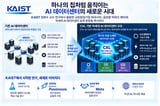
DigitalToday • Sep 9, 2026
KAIST team proposes CXL-based AI data centre architecture with Meta